
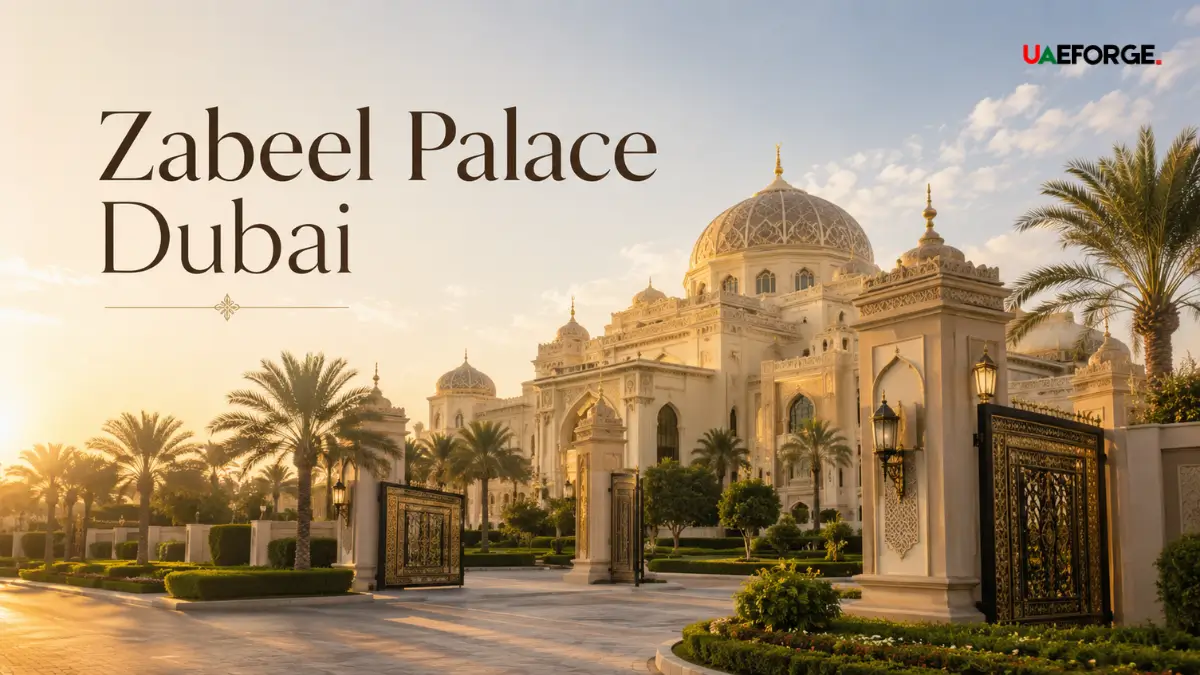
Amidst the grandeur of one of the world’s most ambitious cities, there exists a structure that silently asserts its power, not through glass towers or neon-lit skylines, but through walls that bear the weight of a nation’s story. Zabeel Palace, Dubai is the official royal residence of His Highness Sheikh Mohammed Bin Rashid Al Maktoum, Ruler of Dubai and Vice President and Prime Minister of the United Arab Emirates. Zabeel Palace runs on another wavelength: the ones of utility, tradition and silent power, as opposed to many of the city’s famous attractions that are popular with tourists and camera-loving locals.
The palace itself is not accessible for public tours, but it holds tremendous significance in the cultural, architectural and political fabric of Dubai. Its name, its grounds and its surrounding district all contribute a story of how a Gulf city reshaped itself from a small trade port to a world renowned powerhouse—and how its ruling family has decided to embed that reshaping in heritage and vision.
This article examines Zabeel Palace in all its significant aspects, namely historical roots, architectural conception, strategic position, political function and its connection with the identity and the people of the UAE.
History of Zabeel Palace
The key to comprehending Zabeel Palace is to first understand the role of the Maktoum family in Dubai’s history. Since 1833, when Maktoum bin Butti, of the Bani Yas tribe, moved to Dubai Creek, the Al Maktoum have ruled Dubai. Through the years the family established not only political power, but a real connection with the people of the emirate: one of accessibility, vision and tradition.
During the modern era, Zabeel Palace became the main royal residence of the ruler of Dubai. Zabeel” is the name of the Zabeel district which is a central neighbourhood in Dubai just south of the historic Deira and Bur Dubai. The palace was built and expanded considerably in the last few decades of the 20th century when Dubai’s aspirations were on the rise and the demand for a formal and functional seat of government increased.
Zabeel Palace, unlike the more old-fashioned mud-brick palaces and courtyard houses of early Emirati architecture (which remain visible at Al Fahidi Historical Neighbourhood), was intended to represent both the identity and pride of the Arab-Islamic heritage, as well as the wealth and aspirations of a city-state that was rapidly modernising.
Perhaps the palace is best known for being the home of Sheikh Rashid Bin Saeed Al Maktoum, ruler of Dubai from 1958 to 1990 and credited as the “Father of Modern Dubai”. His son Sheikh Mohammed Bin Rashid Al Maktoum has carried on the tradition of the palace, using it as his home and administrative hub.
Timeless and Majestic Fusion of Architecture and Design
The architecture of Zabeel Palace is one of its most interesting features and is a physical representation of the Dubai identity. The palace complex is designed with a sense of scale and refinement that is appropriate for a modern royal palace, yet it is based on the classical Islamic architectural principles.
Islamic geometric influence can be seen in the exterior and interior design of the palace. The arabesque work, ornate arches, elaborate tile work, and calligraphic effects are all characteristic of the wider Gulf tradition of the decorative geometry as a language of spiritual and aesthetic expression. It’s not about aesthetics: these elements represent continuity of culture, a conscious message that wealth and modernisation do not have to be at the expense of identity.
The palace complex is a vast complex that includes several buildings, guest quarters, ceremonial halls, and administrative buildings. The size of the compound is related to the multiple uses of the house: as a dwelling house and as a house of governance, it must include rooms and spaces for both the private life of the family and official functions, like reception of foreign dignitaries, holding of councils, and conducting of official ceremonies.
The warm whites, creamy sand and gold hues of the Zabeel Palace are reminiscent of the deserts of the Arabian Peninsula. This was done on purpose as it is found in many royal buildings of the Gulf, which are designed to be in harmony with the natural surroundings.
Also, the walls are high around the perimeter and are landscaped with buffer zones to give privacy without being fortress-like in appearance. The overall effect is that of an calm autocrat and not an intimidating force – which is exactly what you want in a ruler who preaches the gospel of ‘visionary leadership that is accessible’.
Location and Environment: Zabeel District
Zabeel Palace is located in the Zabeel district, which is a historic and central part of Dubai. Located strategically in between older neighbourhoods such as Karama and Oud Metha to the south, and the central business arteries of Sheikh Zayed Road and Downtown Dubai to the north and west.
The fact that this is their central position is no coincidence. Its proximity to the hub of city life enables the palace to remain alive with Dubai’s civic and commercial activities, whilst at the same time preserving the seclusion befitting a royal palace.
Some of Dubai’s most iconic structures are located in or near Zabeel:
- The palace grounds are directly adjacent to Zabeel Park, one of the largest urban parks in Dubai, providing the citizens and residents with a green escape amid the city.
- The towering picture-frame monument, Dubai Frame, which connects the old and new Dubai, is situated within Zabeel Park and can be seen from many places in the area.
- Dubai World Trade Centre is just a stone’s throw away, further solidifying the palace’s establishment as the hub of governance and commerce.
The Zabeel district has also expanded itself, and new buildings and public facilities were built, partly in order to enhance and celebrate the importance of the royal palace at its core.
Participate in Government and Official Roles in UAE
The Zabeel Palace is not only a residence, but a place of action of one of the most significant rulers in the Arab world. The palace serves as a venue for various state activities and events, such as meetings with foreign leaders and dignitaries, cabinet meetings, and other official functions. Sheikh Mohammed Bin Rashid Al Maktoum uses the palace as his base for important state functions including meetings with foreign heads of state, cabinet-level deliberations and reception of delegations from around the world.
The UAE is a federation of seven emirates, and Dubai is at the forefront of its economic and diplomatic policies. Zabeel is a well-known address in the language of International Diplomacy, because, as ruler of Dubai, Sheikh Mohammed often conducts his official business in or around the palace complex.
This governorship responsibility also implies that Zabeel Palace is not merely a symbol, but an institution that works. Within its walls, staff, security and administrative units and protocol teams work to meet the needs of the modern head of government whose itinerary includes world business forums, humanitarian events and national development plans.
Additionally, the palace plays a special role during Islamic festivals and events and UAE National Day celebrations, serving as a venue for public gatherings, processions and national pride.
Zabeel Park: The Palace’s Green Neighbour
Next to Zabeel Palace is Zabeel Park, a stunning 47.5-hectare urban park, one of Dubai’s largest. The palace is not open to the public, but Zabeel Park is a democratising alternative, where citizens, residents and visitors can all enjoy the beauty and ambience of Zabeel.
It has a very well developed network of pedestrian and cycling routes, theme gardens, children’s play areas, an amphitheatre and family recreation areas. Within the park, the Dubai Frame is a recently constructed 150-metre-high frame that opened in 2018 and is now one of the most famous places to visit in Dubai, providing panoramic views of both old and new Dubai from its viewing deck.
But it’s not the only thing: the fact that a royal palace and a public park exist in the same district is indicative of a wider principle in Dubai’s governance – proximity between ruler and ruled is a virtue, not a problem. Impromptu public appearances, visits to markets and events without prior warning and a direct relationship with the people sheikh Mohammed governs is what she is famously known for. The Zabeel Park in this context is not just a coincidence, but an extension of this ethos.
Cultural Significance of Dubai Hills is that it is a Symbol of Emirati identity
Zabeel Palace has a cultural significance that goes far beyond its confines. It is a symbol of continuity and evidence that a society can modernise at an astonishing pace whilst maintaining the values, aesthetics and leadership traditions that make up its essence for Emiratis.
The Maktoum family have played a strong role in the cultural fabric of the UAE. In fact, Sheikh Mohammed is not only a statesman but also a poet, a famous horse breeder and a patron of art. He has published a lot of poetry in classical Arabic which is studied in schools in the region. As his residence, the palace takes this cultural resonance with it.
Zabeel Palace is an intentional gesture of permanence in a city that has changed so much over the years. It helps give Dubai historical weight in a particular location and a particular lineage; something newer cities often lack.
On the international level, the palace is a part of Dubai’s soft power. Foreign leaders visit the palace, where negotiations take place on trade deals, security agreements, and humanitarian cooperation. It is a testament to sophistication and rootedness, both of which help to cement Dubai’s reputation as a world player.
Is It Possible To Visit Zabeel Palace? Guidebook filled with Practical Information for Travelers
The first question that comes to the tourist’s and travellers mind about Zabeel Palace is that can they visit this palace. The simple answer is no, as Zabeel Palace is a functioning royal residence and a seat of government, which makes it impossible to have public access.
But a trip to the wider Zabeel area is still very much worthwhile. The following are tips for travellers:
- Visit Zabeel Park: The park is open every day and offers the opportunity to enjoy the ambience of the district, landscaped gardens and close up view of the Dubai Frame.
- Dubai Frame: This landmark in Zabeel Park provides some of the finest vistas of the old and new skyscrapers of Dubai. Tickets can be purchased online or at the venue.
- Visit nearby neighbourhoods: it’s easy to reach nearby neighbourhoods to learn about old Dubai, such as Karama, Oud Metha, and the historic areas around the Dubai Creek.
- Photography spots: The palace’s surroundings and the street line make for great photographs, especially during the golden hour when the warm light dances off the palace walls.
If you want to learn more about royal and historic palaces in the UAE as a whole, the Al Fahidi Fort in Bur Dubai (home to the Dubai Museum), the Sheikh Mohammed Centre for Cultural Understanding and the Sheikh Zayed Grand Mosque in Abu Dhabi are all viable options and offer great insight into Emirati history and culture of governance.
Conclusion
Zabeel Palace is a place of layers. At first glance, it is a closed royal estate in a city which does not close anything to the outside world. Peer beyond the perimeter walls, though, and you discover something rare in the contemporary Gulf: ‘a living institution’ that links an emerging nation to one another’s values, bloodlines and architectural language.
By comprehending Zabeel Palace one comprehends something vital about Dubai itself – that its endeavour has always been lived alongside a deliberate attempt to remember where it came from. The palace does not make its presence known like that of the Burj Khalifa or Palm Jumeirah. It just remains, like it has for the past decades, the quiet center of a city that never sleeps.
Here are 10 frequently asked questions about Zabeel Palace
1. Which of the following is the location of Zabeel Palace in Dubai?
Zabeel Palace is situated in the Zabeel district of Dubai, which is in the middle of Dubai between Downtown Dubai to the north and Karama to the south. It’s near Zabeel Park and Dubai Frame.
2. Who is the resident of Zabeel Palace?
Zabeel Palace is the official residence of His Highness Sheikh Mohammed bin Rashid Al Maktoum, Ruler of Dubai, Vice President and Prime Minister of the UAE.
3. Can people enter Zabeel Palace?
The Zabeel Palace is a working royal palace and governmental building. Not available for public visit or tours.
4. What is the history of Zabeel Palace?
The palace was designed as the main royal residence in the modern period of Dubai’s development, and was traditionally linked to the reign of Sheikh Rashid Bin Saeed Al-Maktoum and later Sheikh Mohammed bin Rashid Al-Maktoum.
5. What is the style of Zabeel Palace?
The palace is a blend of classical Islamic architecture, characterized by its geometric patterns, ornate arches and Arabesque work and the scale and refinement of a modern royal compound.
6. What is the importance of the Zabeel area?
Zabeel is a hub of Dubai, home to the royal palace, Zabeel Park and the Dubai Frame. It is a combination of governance, culture and public life in the city.
7. Can I see Zabeel Palace from outside?
The exterior of the palace can be seen from some of the roads and high points like Dubai Frame. In general, taking photographs of the outside of the palace from public places is allowed.
8. How is Zabeel Palace connected with Zabeel Park?
The palace lands are located next to Zabeel Park. The palace itself is private, but the park is open to the public and includes green spaces and walking trails as well as access to the Dubai Frame.
9. What happens on the occasion of Zabeel Palace?
The palace is used for various state functions, diplomatic receptions, official government gatherings and for ceremonies associated with UAE governance and Islamic events.
10. Do you know of any other similar palaces in the UAE for tourists to visit?
Although Zabeel Palace isn’t open for visitors, there are other venues worth visiting, such as the Sheikh Zayed Grand Mosque in Abu Dhabi, the Al Fahidi Fort and Dubai Museum, and the Sheikh Mohammed Centre for Cultural Understanding, which offers a great immersive experience into UAE heritage and culture.
Read Another Topic: Emirates Road (E611) Dubai Guide

Leave a Comment