
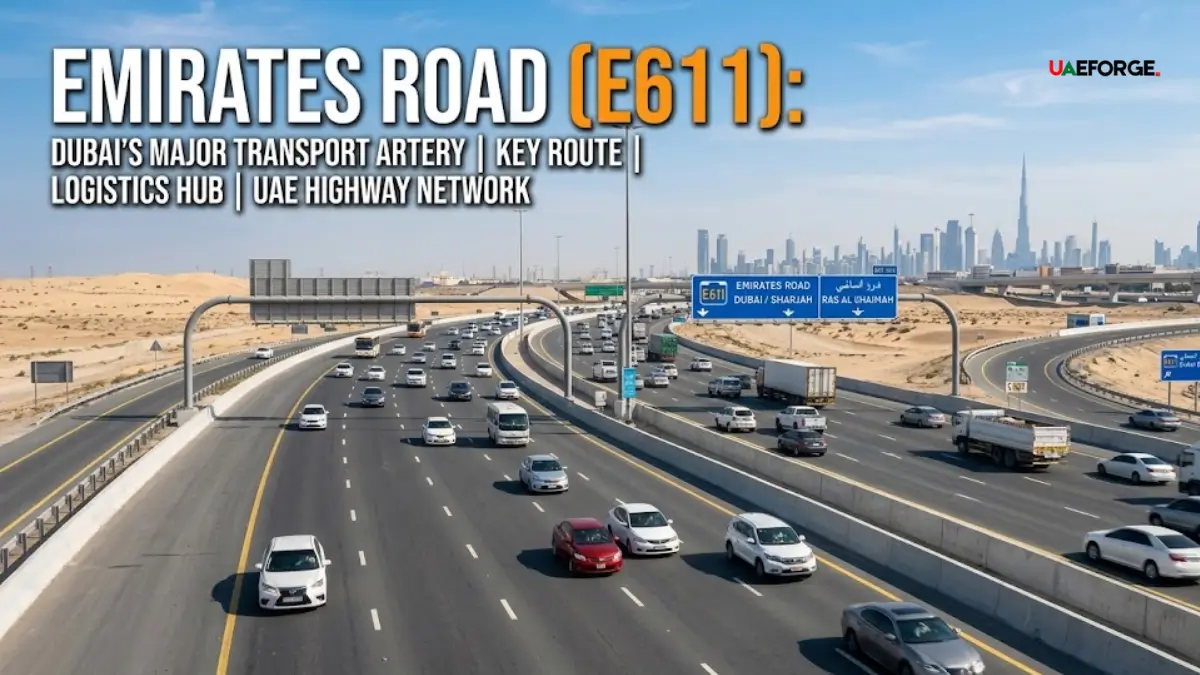
Have you ever driven from Dubai to Sharjah, Ras Al Khaimah, or any other emirate? It is highly likely that you have used Emirates Road (E611). If you have, you now know why Emirates Road is one of the most important highways in the UAE. Emirates Road stretches across many Emirates and connects millions of people and plays a critical role in the economy of the UAE.
Highways are meant to transport people and goods and. Emirates Road goes beyond that. It connects communities in one corridor throughout the UAE. Emirates Road connects residential areas, free zones, industrial areas, business areas, universities, and tourist spots. The Road is a lifeline for commuters, an artery for logistics businesses, and a blueprint for planners and policy makers for the infrastructure of the countries.
This guide offers a comprehensive understanding of Emirates Road concerning its historical background, current direction, landmarks, traffic, and economic impact. It also explains the current traffic laws and innovative future projects.
Vision and Construction: Historical Background of Emirates Road
Abu Dhabi’s and Dubai’s urban centers started experiencing rapid economic and urban growth. The road that connected Dubai to Abu Dhabi became the coastal road (Sheikh Zayed Road, E11). It started experiencing rapid road congestion as a result of the increased population, construction and commercial activities.
The government of the UAE realized the need for a second highway that would run inland. Emirates Road was designed to run parallel to the coastal road to ease congestion. It was constructed to enable the government to develop previously unused areas and control population growth.
Construction of E611 commenced in the late 1990s and the road was fully completed in the early 2000s. Various urban centers (Silicon Oasis, Academic City, University City Sharjah, and many others) started developing around the road. Due to the rapid development around the road, it became an important highway, and every month it carries millions of vehicles. In fact, in certain stretches, it carries as many vehicles as Sheikh Zayed Road.
The Road that Connects all Seven Emirates: Route & Geography
Emirates Road is a major north-south route through the middle of the UAE. It starts at the Dubai-Abu Dhabi border and extends approximately 190 kilometres through the northern Emirates: Dubai, Sharjah, Ajman, Umm Al Quwain, and Ras Al Khaimah.
Road features include:
- Lane Configuration: It is a multi-lane, dual carriageway (typically 3-4 lanes each side) that widens at major interchanges.
- Major Interchanges: Key interchanges are with Sheikh Mohammed Bin Zayed Road (E311), Dubai–Al Ain Road (E66), Al Dhaid Road (E88), and various roads leading to the city centres of Sharjah and Ajman.
- Terrain: The road travels through various desert terrains, semi urban and urban areas, and other suburbs, presenting a highly contrasting landscape to the coastal road.
- Northern Approach: Upon reaching Ras Al Khaimah, the road runs through a mountainous region, with the Hajar Mountains providing a stunning view.
The road’s location is strategic more than it is geographic. It runs through densely packed desert areas and has driven the development of thriving urban and economic areas.
Key Landmarks and Areas
Emirates Road showcases a large number of communities, institutes, and commercial districts. E611 is far from a deserted detour. It is lined with developments of great significance to the UAE.
The following developments in Dubai make clear that Emirates Road is crucial to the movement of traffic along that route regionally and nationally:
- Dubai Silicon Oasis (DSO) — A large integrated community that specializes in tech zones with thousands of tech firms and housing units accessible via E611
- Dubai Academic City — One of the largest clusters of international universities in the UAE with more than 25 university branches which comprise an academic city; a major contributor to traffic on the southern part of the Emirates Road
- Mirdif and Warqa — Residential communities that utilize Emirates Road for commuting
- Dubai Festival City — A major shopping and entertainment destination with direct E611 road access
- Nad Al Sheba and Liwan — Communities of residential master-planned communities that have developed along Emirates Road
In Sharjah:
- University City Sharjah — One of the densest international university clusters in the region and draws a large number of students along Emirates Road
- Sharjah industrial areas — A large belt of manufacturing and warehousing zones that is dependent on E611 for freight
- Al Zahia and Tilal City — Premium residential communities located along the Emirates Road corridor
In Ajman, Umm Al Quwain, and Ras Al Khaimah:
- Ajman Free Zone — An international commercially recognized free zone whose logistics operations are dependent on E611
- Umm Al Quwain’s coastal gateway — Emirates Road serves as the primary entry point into this quieter emirate
- Ras Al Khaimah gateway — The road enters RAK through expanding industrial and resort areas including those adjacent to Al Hamra and Marjan Island
The Daily Commuter Lifeline: Traffic and Commuter Significance
For hundreds of thousands of residents in the Emirates, the road is not merely a means of transport, it is an integral part of their daily lives.
The Sharjah to Dubai commuter corridor is among the top busiest in the Middle East, with a considerable amount of traffic utilizing E611 multiple times in a given day.
Important traffic trends include:
- Peak Hours: The Dubai-bound traffic tends to peak within the time frame of 7:00 AM to 9:30 AM, while the outbound traffic to Sharjah peaks from 5:00 PM to 8:30 PM
- Daily Volume: Weekly peak traffic means that parts of the road around the DSO and Academic City JCT can see more than 200,000 vehicles in a single day.
- Salik Toll Gates: Dubai’s Salik electronic toll system also operates on Emirates Road. The placement of gates aims to control congestion with some level of demand management for entry and exit. Although some congestion has been alleviated, there are still points of merging in the peak hours.
- Incident Hotspots: Merging zone areas of the major interchanges, and crossing the Sharjah border are some of the most statistically accident prone areas of the road.
- Compared to Sheikh Zayed Road: E611 tends to have better flow during non-peak hours, and is the favored choice for many through journeys because of the comparatively fewer commercial entry and exit points.
The advice for all commuters is the same: Use real-time navigation, avoid the 7:30 to 9:00 AM and 5:30 to 7:30 PM times, and remain aware in merging areas.
More than a Road: An Economic Logistics and Trade Corridor
Take away the residential areas, and the Emirates Road is primarily a freight and commercial road. The economic impact is of a staggering scale.
- Free Zone Connectivity: E611 plays a critical role in connecting Dubai Silicon Oasis, Dubai Academic City, Ajman Free Zone, and other Sharjah industrial and media zones, all of which are among the most productive free zones in the UAE.
- Logistics and Warehousing: The roadway’s geographic position and relatively low congestion as compared to coastal routes has focused the largest concentration of logistics parks, cold chain facilities, and distribution centers along the Sharjah and Ajman segments of the roadway.
- Real Estate Premiums: Emirates Road properties achieve significant price premiums, especially within E611’s access zones, which have become leading selling features for the developers of Liwan, Rukan, and Tilal City.
- Airport and Port Access: Emirates Road enables the most efficient connections to Dubai International Airport (via E66 and E311) and to the northern emirate ports, thereby interlinking the import and export logistics chains.
- Supply Chain Backbone: For multinational corporations with operations across multiple emirates of the UAE, E611 is an indispensable component of their supply chain.
Engineering Behind the Highway: Infrastructure and Road Features
Emirates Road, built to provide an inland route to avoid coastal traffic, is an excellent highway that reflects the UAE’s commitment to world-class transport engineering.
Key Features Include
- Speed Limits: Most of Emirates Road sits at a limit of 120 km/h, while other areas can dip to 80–100 km/h, such as school zones and where the road connects with others.
- Service Roads: Much of the road is paralleled by a service road, which provides a lane of access to and from the road, allowing local traffic without interfering with highway traffic.
- Lighting: Most of the road is along a fully lit lane, including raised alternate lanes, merging traffic zones, and other raised structures.
- Barriers and Safety Infrastructure: There are continuous concrete barriers along the center lane to split oncoming traffic. There are also wire rope barriers and crash pads along the alternate lanes that split traffic zones.
- Petrol Stations and Rest Points: There are several ENOC, ADNOC, and EMARAT filling stations along the road, and many offer amenities such as small shops and food.
- Smart Traffic Systems: There are variable message signs (VMS), speed enforcement systems, and traffic monitoring systems that send data to Dubai’s Integrated Traffic Management Centre to monitor traffic in real time.
Emirates Road and Safety Regulations
Like the rest of the sharjah and Dubai’s highway systems, Emirates Road is regulated by strict road traffic safety regulations, governed by Dubai Police and the traffic police officers of the other emirates.
- Speed Cameras: Automated speed enforcement is prevalent along the entirety of the Emirates Road. The system in the UAE works on a 20-km/h buffer zone, meaning if you speed up to 20 km/h over the limit, you will not get fined. In the UAE, this is the legal limit, not a suggestion, and should not be considered a buffer zone
- Lane Discipline: Undertaking, passing on the right, is illegal and is widely enforced. Right lanes are for slower traffic, and left lanes are for overtaking.
- Mobile Phone Use: Driving with a hand-held mobile phone is punishable by a heavy fine. The only legal alternative is a hands-free system.
- Safe Following Distance: Serious accidents are common among high-speed collisions, usually caused by tailgating. Maintain a gap of at least three seconds when traveling at highway speed.
- Truck Restrictions: Heavy vehicles are subject to certain lane restrictions, as well as time-of-day restrictions around most urban interchanges.
Safe driving on Emirates Road means adhering to speed limits, proper lane usage and spacing, and treating every merge point with restraint as a possible hazard
A Road That Keeps Changing: Thinking About What’s New and What’s Next
Emirates Road was never a completed work of engineering. It is built with a vision of the future, the same as the UAE.
Recent and ongoing developments are:
- Interchange Expansions: The Dubai section’s major interchanges have been widened, and additional lanes have been built.
- New Flyovers: Grade separated flyovers have been built on previously signalized intersections.
- Smart Light Upgrades: In line with the UAE’s sustainability initiatives, sections have been outfitted with smart solar lighting.
- Widening Projects: The Ajman and Sharjah corridors have been widened from 3 to 4 lanes in each direction.
- Noise Barriers: To improve the quality of life of residents, noise barriers have been built on sensitive areas of the highway, which was once far from the highway and has now been built.
The Dubai Roads and Transport Authority (RTA) focuses on road improvement, regularly publishes updates on planned works along with Sharjah and Ajman municipalities. Drivers are recommended to check for the latest works and road closures on official communication.
Emirates Road Tomorrow: Future Vision and Development Plans
The vision for the Emirates Road cannot be divorced from the vision for the UAE, specifically “UAE Vision 2031” together with the growth plans of the other Emirates.
Looking ahead:
- Northern Emirates Integration: Sharjah, Ajman, and Ras Al Khaimah’s growing populations are increasing the need for capacity and better design for interchanges on the northern parts of the E611.
- Public Transport Corridors: The planning discussions have included the possible designation of Bus Rapid Transit (BRT) lanes or express bus corridors along Emirates Road, meaning that the usefulness of the road would be extended beyond personal vehicles.
- Smart Road Technology: The UAE’s national planning includes autonomous vehicles, coupled roads (V2X), and AI-based traffic control, and the E611 will be at the forefront of the integration as a primary corridor.
- Sustainability Goals: As part of the UAE’s Net Zero 2050 goals, Emirates Road will be outfitted with electric vehicle charging infrastructure, landscaping sustainability corridors, and environment-friendly street lamps, and the UAE’s commitment to improving its road systems will continue.
- New Community Developments: New communities along the E611 corridor will create an increased demand for road use as well as an increased demand for the use of the planned infrastructure for road use.
Final Thoughts: Emirates Road as the UAE’s Living Spine
Emirates Road holds the stories of the UAE’s vision, growth, and ambition in the nation-building process, and it is much more than a conglomeration of man-made materials and liberal use of speed cameras. Transforming from a road to relieve traffic on Sheikh Zayed Road to one of the most critical and strategic road systems in the nation, Emirates Road aligns with the nation’s economic and social goals.
Whether daily commuter, cross-northern-city shipper, or a weekend escape traffic on your way to Ras Al Khaimah, Emirates Road marks your experience in the UAE, both seen and unseen. Understanding its history, challenges, and direction gives every resident and visitor an advantage to navigate, not just a major highway, but a country in motion.
FAQ’s
By what other names is Emirates Road known?
Emirates Road is formally known as E611 and is often called the “Northern Bypass Road” as it plays the role of an inland road parallel to Sheikh Zayed Road (E11).
How long is Emirates Road?
Emirates Road is approximately 190 kilometers long and runs from its southern end near the Dubai–Abu Dhabi border to Ras Al Khaimah in the north.
Which Emirates does Emirates Road go through?
E611 runs through five emirates: Dubai, Sharjah, Ajman, Umm Al Quwain, and Ras Al Khaimah. It is one of the few roads in the UAE that runs through five emirates.
What is the speed limit on Emirates Road?
The speed limit on Emirates Road is generally 120 km/h. It is usually 80–100 km/h near interchanges, school zones, and construction areas.
Are there Salik tolls on Emirates Road?
Yes, Salik operates along Emirates Road in Dubai. Drivers without a Salik tag will incur fines. Salik is a fully electronic system (there is no cash payment at the toll).
Can heavy trucks use Emirates Road?
Yes, Emirates Road is a primary corridor for freight throughout the UAE. There are lane restrictions for heavy vehicles (usually the right-hand lanes) and restricted access at certain times in urban segments.
What are the best alternatives to Emirates Road during peak times?
The best alternatives are Sheikh Mohammed Bin Zayed Road (E311) and Sheikh Zayed Road (E11). Al Ittihad Road (E11 coastal) is best for Sharjah-Dubai travel, along with Al Wahda Road, although they both experience congestion.
Is there fuel along Emirates Road?
Yes, there are fuel stations, including ENOC, ADNOC, and EMARAT, located along Emirates Road at clusters of interchanges along the road.
What main communities and/or developments are located along Emirates Road?
They include Dubai Silicon Oasis, Dubai Academic City, Mirdif, Al Zahia (Sharjah), Tilal City, Liwan, Rukan, Ajman Free Zone, and various communities in Ras al Khaimah.
Will Emirates Road be included in the UAE’s future smart transport programs?
Definitely. With consideration to the UAE Vision 2031, Emirates Road will be included in the UAE’s smart road, autonomous vehicles, and BRT (Bus Rapid Transit) systems, in addition to the integration of V2X, AI traffic management systems, and the increased provision of EV charging infrastructure.
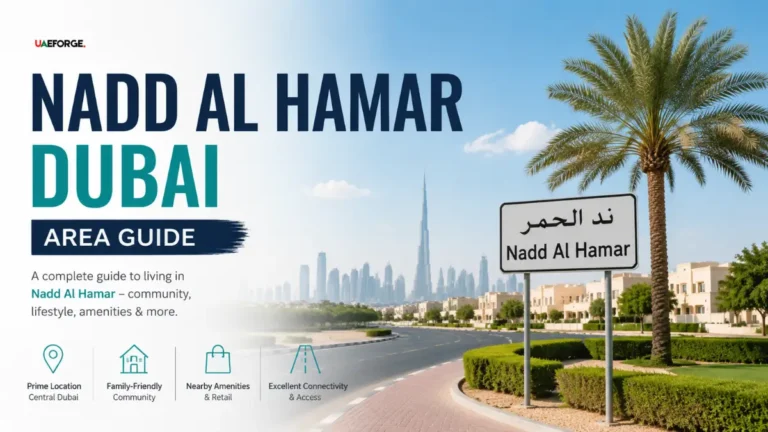
Read Another Topic: Nadd Al Hamar Dubai
Leave a Comment