
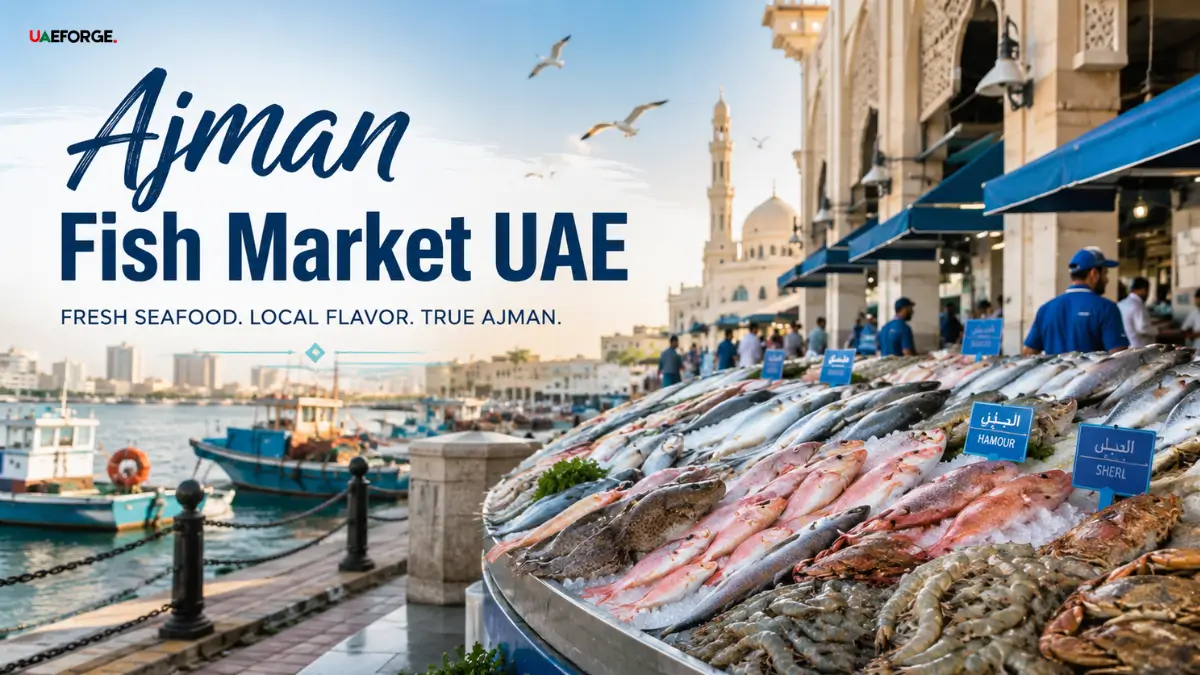
The Ajman Fish Market is one of the most authentic, untouched experiences in the UAE, nestled along the beaches of the glittering Ajman Corniche. What separates this working waterfront souq from the glittery malls and luxury developments that rule much of the Emirates is the fact that it runs on its own ancient schedule—one based on nothing but tides, catch and the communal energy of fishermen, traders and seafood aficionados that descend here before most of the city has had its morning tea.
If you’ve been a resident of the Northern Emirates for a while and you’re in need of fresh hammour, or you’re a tourist who wants to see what life is like at the source, or a home chef looking for the best catch on offer, the Ajman Fish Market will not disappoint.
Whether you are new to the market or looking to visit the best seafood shops, this guide offers you all the information you need, including the market’s history, its layout, tips for buying, types of seafood, and more.
Brief History: Fishing as the Soul of Ajman
Before oil wealth changed the UAE, the sea has been the chief source of sustenance and income for the coastal communities all across the Emirates. The smallest of the seven emirates in terms of land area, Ajman was historically one of the busiest fishing locales on the Arabian Gulf. The creek, a natural watercourse, Ajman Creek, enabled the free movement of dhows and traditional wooden fishing boats in and out of the open sea and the protected inland waterways.
The fish market has evolved as a formal entity from the time immemorial when the fishers used to sell their fish directly from the beach. Today, the modern building of the Ajman Fish Market, renovated in recent years as a part of the wider Corniche development initiatives, retains that pier-side identity, but with a more organized layout, better hygienic facilities and accessibility for visitors.
Continuity, that is the key along with age that makes this market historically significant. Numerous fishermen who deliver their catch here are the descendants of fishermen of the past who have fished these waters for generations. The expertise in trade routes, species knowledge and seasonal expertise that has been passed down through these families lends the Ajman Fish Market its depth of authenticity which cannot be manufactured.
Location and Practical Access – Getting There
It is on the Ajman Corniche Road, beside the Ajman Creek, in the middle of the emirate, where the Ajman Fish Market is situated. It’s near Ajman Palace Hotel, and easily identified by the presence of fishing boats docked in front of it and the scent of fresh seafood, long before the building can be seen.
- Parking: Cars have parking assigned along the Corniche and in the surrounding municipal parking lots. The best time to park is during the 6:00 AM – 9:00 AM time block on weekdays.
- By taxi or rideshare: Taxi or rideshare drivers will know where to go if they are told “Ajman Fish Market” or “Souk As-Samak Ajman”. The journey from Dubai – Al Qusais or Deira is usually 30 to 45 minutes depending on the traffic.
- Public transport: There is a bus service from the central bus station in Ajman that runs between the Corniche area. Routes also go to the waterfront area of Ajman from Sharjah.
The best time to visit the market is from 5:30 a.m. to 10 a.m. when the fishermen come back with the catches they made during the night and early in the morning. A second, lower energy wave of activity is seen in the late afternoon, between 4:00 PM and 7:00 PM. Visits can be made in the middle of the day, although the variety is reduced at this time.
The Market’s Layout and What to Expect
The Ajman Fish Market is a multi-sensory and immersive experience. The main building is broken into functional zones that serve other purposes, and knowing how it is organised will help you navigate with confidence.
The Wholesale and Auction Zone is open in the very early hours of the morning, from about 5:00 AM to 7:30 AM. The fishermen come to this place and the buyers such as restaurant owners, hotel suppliers and wholesale traders call out offers for bulk quantities. It’s here you experience the basics of the economic pulse of the market. Transactions here are mostly B2B, but visitors are welcome to observe.
The Retail Fish Stalls is the core of the market for daily consumers. On ice slabs and open trays, dozens of vendors offer their catch, which is roughly sorted by the type of fish. Large, prize hammour (grouper), kingfish, and smaller reef fish, sardines and crustaceans are expected. Vendors are loud, competitive and usually very willing to tell you what they’re selling, how it was caught, and how best to cook it.
One of the most useful features is the Cleaning and Preparation Counter. Fish will be gutted, scaled, filleted or portioned as desired by the fish vendors or cleaning staff who are available after the purchase, for a very small extra charge, or as part of the purchase price. This is a significant convenience particularly for someone who does not know how to prepare fish.
The Shrimp and Shellfish Section is typically located on one side of the market with large baskets and ice boxes holding prawns, small crabs and, depending on the season and catch, lobster and squid.
Dried and Salted Fish Stalls are for those who want to try seafood that’s been dried and salted, a common ingredient in traditional Emirati and South Asian cuisine. Here you can find dried sardines, salted anchovies and smoked anchovies.
The Most Important Species of Fish in Ajman Market
The Ajman Fish Market showcases the wealth of the waters of the Arabian Gulf and the seafood caught in the Indian Ocean, which is imported to UAE via fishing and import.
It is no question Hammour (Orange-Spotted Grouper) is the undisputed king of Gulf seafood. Hammour is dense, white and slightly sweet, and is a highly valued meat in the UAE for grilling, baking and traditional rice dishes such as machboos. Fresh hammour fish is one of the best hammour found in the Northern Emirates at the Ajman market.
The most popular Fish for Grilling and Steaks is Kingfish (Seer Fish / Spanish Mackerel). It has firm flesh which stands up well under high heat, and is common in Emirati and South Asian cooking. Check out for skin which is shiny, clear eyes, and firm texture when choosing.
Sheri (Emperor Fish) is a popular local fish which can be baked and whole roasted. More flavorful than zucchini, it pairs well with slow cooking with herbs and lemon.
Zubaidi (Silver Pomfret) is a delicate fish, which is flat and is in very high demand and hence is selling at premium price. It’s traditionally cooked pan-fried with hardly any spices to retain its natural sweetness.
Bayadh and Farsh are two other gulf species that are frequently sold in the market and can be a little easier to find than hammour and zubaidi, but can be just as satisfying when properly prepared.
Tiger Prawns and White Shrimp are also abundant, especially during the shrimp season in the Gulf (October through March) when cooler temperatures come into play. Prices are not too expensive, and usually freshness is guaranteed by the amount of business that is done.
Cuttlefish and Squid are popular among the large expat community from South Asia, and are often sold year round.
Prices, Tips on Bargaining, and What to Look for When Purchasing
Among the most popular queries about the Ajman Fish Market is if a bargain is anticipated. The truthful answer is: it depends on the vendor and the quantity. When a few kilograms are bought at the retail price, this is either fixed or negotiable with a limited margin. It is quite normal and acceptable to negotiate, for example, several kilos of a particular species, or if it’s for a gathering.
Useful tips for making the most of your visit:
- Go early. The selection that we’re looking at is significant between 6:00 AM and 10:00 AM. The most popular hammour and zubaidi are sold out quickly.
- Use eyes and nose to check for freshness. Bright clear, slightly protruding eyes are a sign of fresh fish, not cloudy or sunken. The gills should be bright red or pink. The flesh should be firm and bounce back. It should have a fresh ocean aroma, not a strong “fishy” aroma, which is a sign of age.
- Request the fish to be cleaned at the time of the catch. This is a regular service as vendors are proud of preparing fish well. State fillets, steaks or whole-cleaned, depending on the method of cooking.
- If possible, visit during the middle of the week. On weekends (Fri & Sat) the visitors numbers are considerably higher, resulting in more competition for the best stock, and a little bit more expensive. The quietest and most relaxed times for buying will be Tuesday to Thursday mornings.
- Carry small change and coins. Some stalls have converted to accepting payments by card, but cash is the mainstay of transactions; and exact change keeps transactions flowing.
Cultural Fabric: More than the Purchase of Fish
The Ajman Fish Market is a lot more than a retail outlet. It is a living social institution in which the cultural fabric of a society is expressed in which fishing was more than an occupation, it was a way of life. A brief visit provides a real glimpse at life in the Emirate and the Northern Emirates that you won’t see in shopping centres or tourist attractions.
The early-morning prayer calls, the mixture of Emirati fishermen in kandura and Baluchi, Iranian and South Asian crew members, the cardamom coffee from a nearby tea stall, the rhythmic sound of ice being shoveled across concrete — all these add up to a lot more than a simple exchange.
Many of the fishermen and vendors don’t speak English well, but they communicate quite well using gestures, weights, and numbers. But here, a respectful and patient attitude is more of a key than any words. A simple “kam?” A little bit (how much?) goes a long way.
Photography is generally tolerated, but ask before taking a picture of any particular vendor/worker. Many of them will wave you on with a smile; others want to keep to themselves and that is fine.
Around the area: A morning of it
The Ajman Fish Market is part of a larger fish market which has some great additional places to visit in this Corniche waterfront area that can be done all in one morning.
The fish market experience is enhanced by the historical background in the Ajman Museum in an 18th century fort just minutes from the Corniche. The collections relating to pearl diving, traditional dhow construction and life before oil are directly attributable to the maritime culture that can be observed at the market.
Visitors can see the old art of wooden boat-making at the Ajman Dhow Yard, near the Creek, which has been used by Gulf fishermen for centuries. Traditional dhows are still being constructed here with ancient techniques by master craftsmen.
It’s the Corniche Walk and Beach where you can take a break from the hustle and bustle of the market and sit in cafes or shisha spots, overlooking the water.
After your market experience, head to one of the small Emirati and Iranian owned restaurants on Corniche Road for a good breakfast of fresh juice, karak tea, paratha and egg dishes, which will complete a perfect morning.
The Future of Gulf Fishing and Sustainability
It should also be noted that the richness at the Ajman Fish Market occurs against a background of the overall concern for overfishing and dwindling fish stocks in the Arabian Gulf. Seasonal fishing closures have been implemented, including the commercial fishing ban during the summer months from June to August, which is intended to provide fish populations time and space to recuperate and reproduce. All of these seasonal changes are evident in the Ajman market, where activity is lower in protected seasons and other species are found.
By discriminating against over-exploited species and asking retailers where fish were caught, and by not buying undersized or juvenile fish, consumers can make a positive difference. The health of the marine ecosystems that markets draw from is essential to the long-term health of these markets.
Conclusion: The Market Worthy of Your Early Morning
If you’re willing to get up before the sun, you’ll be rewarded at the Ajman Fish Market. There’s something irreplaceable about standing next to a fisherman’s fresh catch and haggling with a vendor whose family has sold fish here for as long as anyone can remember, and leaving with fish that still smells of the sea.
One of the rare places in the present-day UAE that operate according to a non-commercial time, of tides and nets and the first light over the Gulf. Be early, be curious, and be hungry!
Frequently Asked Questions (FAQs)
1. What is the opening time at Ajman Fish Market?
The market is open very early (5.00 AM) as soon as the fishermen come with the fish and is active until about 1.00 PM. A smaller afternoon session is from approximately 4:00 PM to 7:00 PM. The best time to go for variety and freshness is in the early morning.
2. In which location is the Ajman Fish Market?
Located on the Ajman Corniche Road, near Ajman Creek waterfront, near the Ajman Palace Hotel in the middle of the emirate.
3. Is it okay to bargain at Ajman Fish Market?
Bargaining is OK, especially when it comes to bigger items. The prices for small volume purchases are usually semi-fixed. Negotiate in a polite and respectful manner.
4. Is there a place at the market to clean and fillet fish?
Yes. Most vendors will clean, gut, scale and fillet on-site for an extra charge or for the price of the fish when you buy it.
5. Which fish is the most demanded fish in Ajman Fish Market?
Popular fishes like ‘hammour’ (grouper), kingfish, ‘zubaidi’ (silver pomfret) and ‘sheri’ (emperor fish) are among the popular ones. Tiger prawns and fresh shrimp are also highly sought after.
6. Is the Ajman Fish Market open on weekends?
Yes, the market is open every day of the week including Friday and Saturday. But weekends are quite a lot busier and a weekday morning visit is recommended for quieter visiting.
7. Is it possible to tell if the fish is really fresh?
Check for bright, clear eyes, bright, red gills, flesh that bounces back after pressure is applied, and a clean ocean scent and not a heavy fishy odor. The vendors are being provided with fresh deliveries daily and quality is quite good in the early morning hours at the market.
8. Is there any seafood other than fish?
Absolutely. Tiger prawns, white shrimp, squid, cuttlefish and in season crab and lobster are available regularly in the market.
9. Is it worth visiting for tourists, the Ajman Fish Market?
Very much so. Apart from purchasing seafood, the market is a true insight into the traditional Emirati sea culture and lifestyle that you can seldom find in normal tourism.
10. Can you park your car near the Ajman Fish Market?
Yes. Street level parking on Corniche and in nearby municipal lots. Parking is easy if arriving before 8:00 AM on weekdays.
Read Another Topic: Clock Tower Sharjah


Leave a Comment