
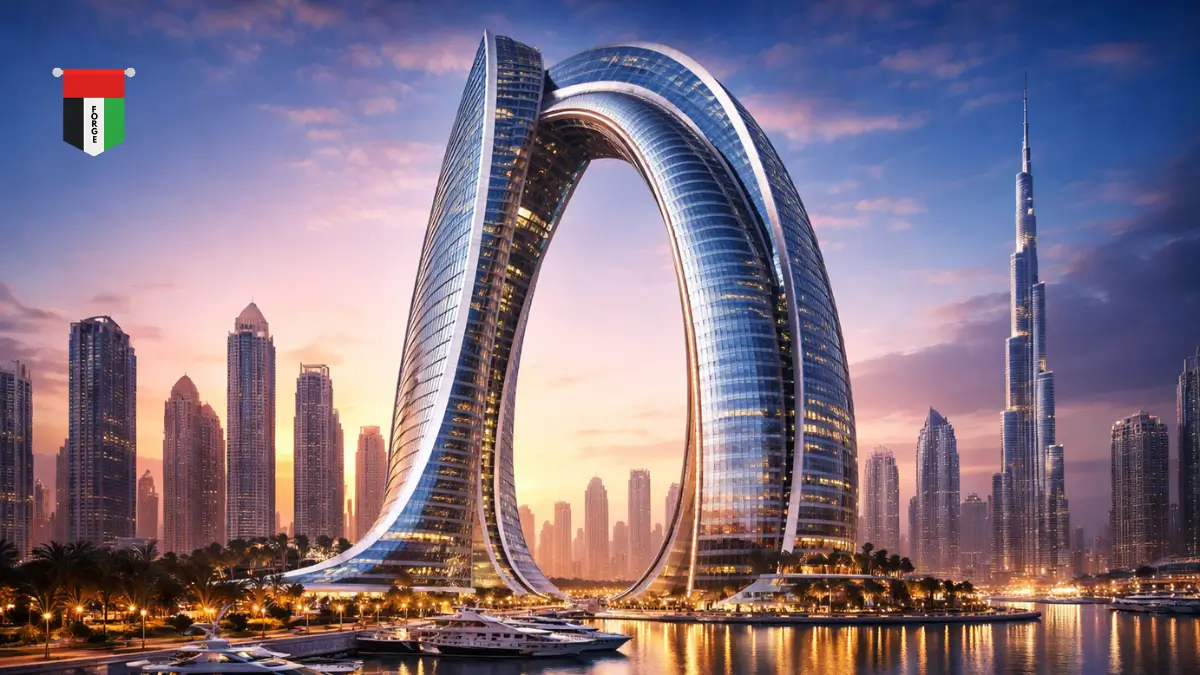
Dubai never constructs anything silently. Since the high tower of the world to a palm-shaped archipelago, which comes out of the Arabian Gulf, the emirate has never regarded architecture as a different kind of storytelling – audacious, uninhibited, and promoted worldwide. Today, a new chapter is being drawn. The Dubai Arch Tower is about to be one of the most discussed buildings of this decade not because it aims at breaking the height record, but because it is not afraid to be unique in its form, soul and symbolism.
The arch, one of the most ancient structural designs of humanity, has been re-invented here at a scale and ambition that the world has never witnessed in the skyscraper scene. Although the majority of towers are just competing in terms of vertical height, the Dubai Arch Tower opens a horizontal conversation to the skyline, a sweeping curve that encompasses the skyline and beckons the eye to linger. It is not a mere building. It is an entry point – architectural, cultural and economic.
This article discusses the Dubai Arch Tower in all dimensions: its design philosophy, engineering issues, location, its economical role, and how it will become one of the most iconic man-made buildings in the world.
Location & Strategic Positioning
The location is all in real estate. The planners of Dubai have located the Arch Tower in a high visibility area which will give the tower the maximum possible symbolic value as well as make the tower commercially viable. The location of the tower also provides it with access to the current and future transport infrastructure, and places it within a fairly accessible distance of the Dubai International Airport and the growing metro system of the city.
This anchor project is of great benefit to the surrounding district. Large landmark developments in cities lead to what economists refer to as an agglomeration effect in this process- surrounding businesses, hotels and residential developments increase in value just because they are close to a known icon. This has occurred in Dubai on multiple occasions:
- The territories around the Burj Khalifa, the Palm Jumeirah as well as the Dubai Creek Harbour are priced substantially above the average price since the landmark increases the reputation of the whole area.
- Location with the greatest exposure to the skyline – the arch shape is made so that it can be visible among various approach paths into the city.
- A close proximity to luxury retail and hospitality as well as waterfront promenades adds value to the lifestyle of residents and visitors.
- Metro and road accessibility incorporated in the masterplan will mean that the tower can be accessible without causing a lot of traffic strain to the surrounding streets.
- In a free zone or special investment area, which may come with tax benefits and ownership rights to foreign buyers and companies.
Dubai Arch Tower — Key Facts at a Glance
| Attribute | Details |
| Location | Dubai, United Arab Emirates |
| Design Concept | Monumental arch-form skyscraper |
| Primary Use | Mixed-use: Residential, Commercial, Hospitality |
| Key Features | Sky bridge, observation deck, smart building systems |
| Development Context | Part of Dubai’s 2040 Urban Master Plan |
| Architectural Style | Neo-futuristic with Arabic design influences |
| Sustainability Goal | LEED Platinum / Net Zero Carbon targets |
The Vision
The association of Dubai with ambitious architecture is no secret. The emirate has long realized that signature buildings are not just a place to put people but they convey the dreams of a civilization to the whole world. This is the philosophy that Dubai Arch Tower is based on. It is an architectural thesis: that a building may also serve as a home, a business district, a tourist site and a national icon.
There is a profound cultural appeal of the arch motif within the Arab world. Gates and arches have been traditionally a symbol of welcome, protection, and passage – gates between the common and the extraordinary. Scaling this shape to unseen heights, the Dubai Arch Tower takes a traditional image and puts it in a new setting. It reads, in concrete and steel: you are getting into a place that cares about its heritage yet is rushing to its future.
The project is also very much in line with the 2040 Urban Master Plan in Dubai which envisages the expansion of the livable and investable areas of the emirate, the growth of green space and the diversification of the economy beyond oil through real estate, tourism and innovation. Mega-projects, such as the Arch Tower, are not architectural accidents, but rather the conscious tool of urban policy.
The vision of the tower has several key pillars, which are:
- Developing a world-famous silhouette to make the skyline of Dubai stand out in a different dimension.
- A mixed-use destination, integrating luxury living, global business and hospitality of the highest standards, all in a single building.
- With the principles of sustainable development, the target of net-zero carbon operations with solar integration and passive cooling design.
- Increasing its economic presence in the surrounding district through the attraction of high-end tenants, high net worth residents and millions of visitors each year.
- Strengthening Dubai as the hub of 21st-century city innovation.
- Creating a globally recognizable silhouette that distinguishes Dubai’s skyline beyond the vertical plane
- Serving as a mixed-use destination that merges luxury living, international commerce, and world-class hospitality under one roof
- Embodying sustainable development principles, targeting net-zero carbon operations through solar integration and passive cooling design
- Boosting the economic footprint of its surrounding district by attracting premium tenants, high-net-worth residents, and millions of annual visitors
- Reinforcing Dubai as the epicenter of 21st-century urban innovation

Architecture Design and Engineering
Structurally, the Dubai Arch Tower will be a frontier challenge. The second type of tall buildings is mostly vertical columns- simple in terms of the manner in which they disperse gravitational forces vertically. A skyscraper of an arch form adds lateral forces, uneven distribution of weight and a whole new range of structural requirements. Engineering teams that have been working on this project have been forced to reconsider some of the basic assumptions regarding how a tower can stand.
The arch is made up of two tower legs that do not originate out of their foundations, but rather meet and join above them at a common crown – a sky-level bridge which makes the top of the arch. This bridge is not a mere ornament. It is a structural support which corrects the outward bulge of the two legs, the same way that the keystone of a Roman arch supports the whole structure in compression. At this size, though, such a balance can only be achieved by using high-performance concrete cores, an exoskeletal steel diagrid frame, and moment-resisting joints that are engineered to an exact degree of accuracy.
What is exceptional about this design, engineering wise:
- Diagrid exoskeleton: The external steel grid takes up wind loads, and minimizes the requirement of internal shear walls, allowing dramatic floor plans.
- Tuned mass dampers: These huge counterweights are situated on the crown bridge and automatically fill the sway that occurs in response to desert winds and seismic activity.
- High-performance concrete: Each tower leg core is made of ultra-high-strength concrete with compressive strength over 100 MPa – virtually three times higher than standard building concrete.
- Thermal engineering: The desert climate requires that facades should have minimal heat gain of the sun; the tower is designed with a high-performance unitized curtain wall in a high-performance double-glazed curtain wall with in-built photovoltaic cells.
- Foundation depth: This has deep pile foundations, dug into the rock strata below Dubai, to hold the structure stationary as the arch geometry causes the earth and water to push outward.
- Sky bridge construction: The crown connector was constructed as a mixture of temporary propping and incremental launching – a method inspired by the long-span bridge construction.
- Diagrid exoskeleton: The outer steel grid absorbs wind loads while reducing the need for internal shear walls, opening up floor plans dramatically
- Tuned mass dampers: Located in the crown bridge, these massive counterweights automatically compensate for sway caused by desert winds and seismic activity
- High-performance concrete: The core of each tower leg uses ultra-high-strength concrete with a compressive strength exceeding 100 MPa — nearly triple that of conventional building concrete
- Thermal engineering: The desert climate demands that facades minimize solar heat gain; the tower uses a high-performance double-glazed unitized curtain wall with integrated photovoltaic cells
- Foundation depth: Each leg requires deep pile foundations drilled into Dubai’s underlying rock strata, anchoring the structure against the outward forces generated by the arch geometry
- Sky bridge construction: The crown connector was assembled using a combination of temporary propping and incremental launching — a technique adapted from long-span bridge engineering
The Dubai Arch Tower is a skyscraper that can be compared in the world with significant constructions that have a similar geometric desire – but much larger in height. The Gateway Arch in St. Louis is a mere 192 metres high. The Dubai Arch Tower converts that stereotype into a commercially functioning and completely inhabited supertall, and therefore, indeed unprecedented in the history of built form.
Strategic Location Highlights:
- Positioned for maximum skyline visibility — the arch silhouette is designed to be distinguishable from multiple approach corridors into the city
- Close proximity to luxury retail, five-star hospitality, and waterfront promenades enhances lifestyle value for residents and visitors
- Metro and road connectivity built into the masterplan ensures the tower is accessible without adding significant traffic burden to surrounding streets
- Located within a free zone or designated investment district, offering potential tax and ownership advantages to international buyers and businesses
Amenities & Interior Experience: Life Inside the Arch
The Dubai Arch Tower is designed as a full-fledged vertical metropolis, a closed ecosystem where its occupants, office employees, hotel customers, and tourists have their own worlds within the building. The interior programme is layered in terms of height, with the lower levels being occupied by commercial and retail uses, offices and hospitality in the mid-storeys, and luxury apartments reaching high up the sides of each of the legs.
The crown bridge – the summit of the arch – is the location of the most exciting experience proposals in the tower:
- 360-degree panoramic views over Dubai coastline to the horizon of the desert, 360 feet (1,000 feet) tall, with an observation deck open to the public — one of the tallest public observation decks in the UAE.
- Signature sky lounge/ fine dining concept under the management of an internationally renowned hospitality brand, suspended between the two tower legs and at hundreds of metres of height.
- Sky pool, infinity-edge, available to the hotel guests, located in such a way that its sights are maximized throughout the city.
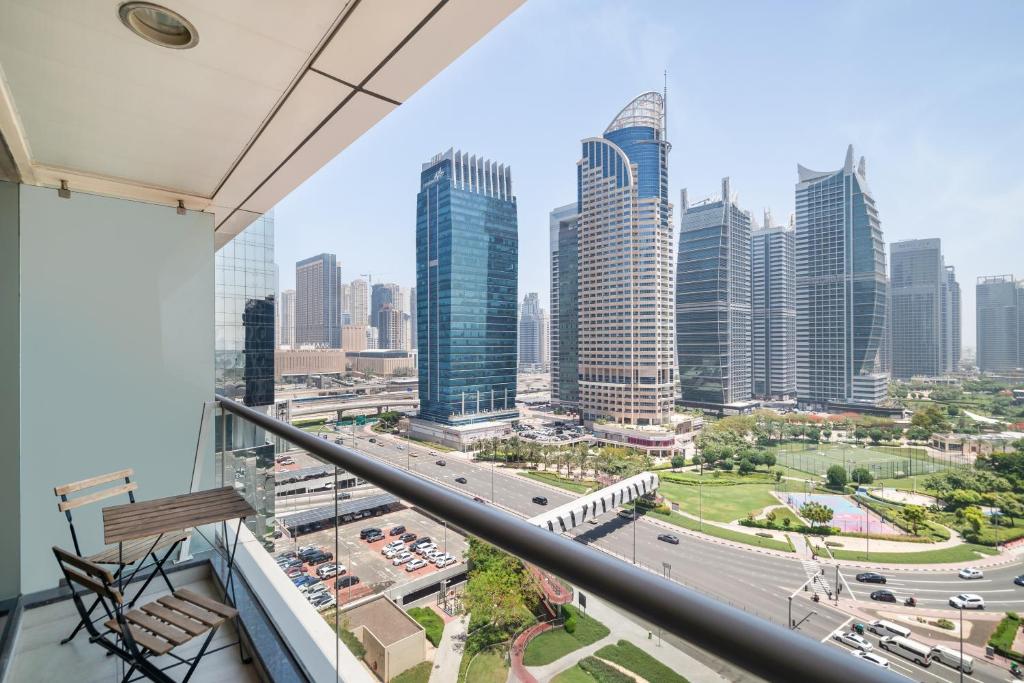
- Residential units with floor-to-ceiling glazing, personal terraces, and integration of a smart home – residential areas of one-bedroom apartments through large four-bedroom sky penthouses.
- Grade-A office spaces with flexible floor plan, biophilic design features and special concierge services tailored to multinational companies.
- Select luxury at the base, with international fashion brands, specialty restaurants, and an art gallery with Emirati and global contemporary art.
- Smart building system: AI-based energy management, predictive maintenance, facial recognition access control, and resident-services app.Wellness amenities such as full-floor spa and fitness centre, meditation garden, and hydrotherapy pools.
- Sky observation deck with 360-degree panoramic views stretching from the Dubai coastline to the desert horizon — offering one of the highest public viewpoints in the UAE
- Signature sky lounge and fine dining concept operated by an internationally acclaimed hospitality brand, suspended between the two tower legs at hundreds of metres of elevation
- Infinity-edge sky pool accessible to hotel guests, positioned to maximize sightlines across the city
- Residential units featuring floor-to-ceiling glazing, private terraces, and smart home integration — with units ranging from curated one-bedroom apartments to expansive four-bedroom sky penthouses
- Grade-A office spaces with flexible floor plates, biophilic design elements, and dedicated concierge services designed for multinational corporations
- Curated luxury retail at the base, including international fashion houses, specialty dining, and an art gallery showcasing Emirati and global contemporary art
- Fully integrated smart building system: AI-driven energy management, predictive maintenance, facial recognition access control, and app-based resident services
- Wellness facilities including a full-floor spa and fitness centre, meditation garden, and hydrotherapy pools
Economic Effect
In Dubai, there is no such thing as a large-scale architectural project that is nothing but an aesthetic exercise. The Dubai Arch Tower is a multi-billion-dollar project whose benefits are likely to be realized in a number of economic aspects at the same time.
There are direct and indirect economic contributions:
- Construction-phase employment: Thousands of skilled and semi-skilled workers — from structural engineers and facade specialists to MEP contractors — will be employed across the multi-year build programme
- Real estate value uplift: Residential and commercial properties in the surrounding district are expected to see significant capital appreciation following the tower’s announcement and, more dramatically, upon completion
- Tourism revenue: As a distinctive architectural attraction, the tower’s observation deck and sky lounge alone could generate substantial annual visitor revenue, adding to Dubai’s already formidable tourism economy
- Foreign direct investment (FDI) magnet: Luxury real estate in iconic towers consistently attracts high-net-worth international buyers from Europe, Asia, and the Americas — bringing long-term capital into the UAE
- Hospitality and F&B ecosystem: The hotel, restaurants, and retail tenants within the tower will create a self-reinforcing commercial ecosystem generating ongoing employment and tax revenue
Dubai has always shown that transformative architecture can provide transformative economic results. In 2010, with the opening of the Burj Khalifa, a new wave of development occurred in Downtown Dubai, which made the area one of the most valuable urban precincts in the world.
Dubai Arch Tower vs The Other Icons in Dubai
To establish the place of the Dubai Arch Tower in the architectural history of Dubai it is prudent to look at the structures that came before it. The Burj Khalifa – the tallest building in the world at 828 metres – made its mark in the world arena by seeking nothing but sheer vertical dominance. The Burj Al Arab, with its silhouette resembling a sail, proved that shape can be a brand image. The Dubai Frame reduced architecture to metaphor of itself. Every project was a new dimension of what the built environment of Dubai could say.
The Dubai Arch Tower is a step in the right direction within this discussion. Instead of being taller than the Burj Khalifa, it proposes a different axis. It poses a question: what would happen to a skyscraper that is not characterized by its height, but by its form as it appears in relation to the sky? Thus it introduces a whole new genre of building aspiration.
The Arch Tower is different in the following aspects when compared to its predecessors:
- Form factor: Unlike the single vertical shafts, which most Dubai towers are, the Arch Tower is a dual-leg structure that is interconnected at the crown – visually distinctive in all angles and directions.
- Programming philosophy: Unlike single-purpose luxury towers, the Arch Tower is mixed-use to the core, both up to the crown and down to the ground, to form 24-hour activation of commercial, residential and hospitality services.
- Symbolic register: The arch form addresses to invite, passage, and change – a more laden symbolism than the naked ambition of height of a conventional supertall.
- Engineering novelty: The architectural problem of constructing a habitable arch at supertall scale is truly a first of its kind, and this project is in an entirely new category in engineering history.
- Form factor: Where most Dubai towers are singular vertical shafts, the Arch Tower is a dual-leg structure connected at the crown — visually unique from every angle and direction
- Programming philosophy: Unlike single-purpose luxury towers, the Arch Tower is fully mixed-use from ground to crown, creating 24-hour activation across commercial, residential, and hospitality functions
- Symbolic register: The arch form speaks to welcome, transit, and transformation — a richer symbolic vocabulary than the pure height ambition of a traditional supertall
- Engineering novelty: The structural challenge of building a habitable arch at supertall scale is genuinely unprecedented, placing this project in a category of its own in engineering history
Timeline Construction and Project Status
Just like any mega-project of this magnitude and scope, the Dubai Arch Tower is developed in a well-timed sequence. The large supertall buildings usually have multi-year schemes that pass through different stages; design development and approvals, foundation and substructure, superstructure, facade, fit-out and landscaping, and lastly commissioning and handover.
- Concept design and feasibility: Phase of architectural competition and conceptual design, and phase of developer approval and public announcement.
- Design and regulatory approvals: Structural, MEP, and facade engineering prepared in detail and submission to Dubai Municipality and authorities.
- Foundations: Deep-pile foundation of tower legs on both sides – one of the most important stages due to the asymmetry of the load distribution of the arch shape.
- Construction of the superstructure: The elevation of both tower legs above ground to the crown – the most aesthetically noticeable stage that will be visible in the skyline throughout the construction.
- Crown bridge construction: The engineering highlight of the project – the sky-level interconnection between the two legs has to be installed with extreme accuracy at high levels.
- Facade, fit-out and MEP: Interior fitting and installation of the curtain wall system, finishing the visual identity of the tower.
- Commissioning and opening: Final checks, tenant fit-outs and the grand opening – expected to create an international media spectacle to rival any landmark opening in recent history.
Cultural/Symbolic Meaning
Greatest monuments in the history of man have always been greater than their materials. The Colosseum is a description of Roman might and drama. The Eiffel Tower conveys industrial modernity, and French national pride. The Sydney Opera House is a representation of the cultural ambitions of a young nation in search of its voice. It is not the tall or complicated nature of such structures that make them dear to us, but rather the fact that they have a meaning.
This dimension of meaning is taken into consideration in the design of the Dubai Arch Tower. One of the oldest and the most universal constructions in the world is the arch, and an element of passage, welcome and change. When it comes to the UAE, it also has a reflection of the traditional Islamic archway, the triumphal gate and the concept of a gateway to worlds. Being under the Dubai Arch Tower will be to be under a figurative intersection – between the deserts and the sea, between the past and the future, between the local and the global.
It has a cultural meaning on multiple levels:
- National identity: The tower is an expression of the founding myth of the UAE of transformation – of the pearl-diving village to the world metropolis – in one generation.
- Soft power: Iconic architecture will expand the cultural influence of a nation way beyond its borders; the Dubai Arch Tower will be copied in millions of social media posts, travel videos, and architecture magazines every year.
- Tourism magnetism: Tourism is propelled by the most photographed and photographed buildings in the world in a way that it cannot possibly be duplicated by traditional marketing.
- Motivation to the future generation: To Emirati architects, engineers and urban planners, a project with such a grandiose is an indication that in their own country, the most fantastic ideas can be achieved.
- National identity: The tower reflects the UAE’s founding narrative of transformation — from pearl-diving village to global metropolis — within a single generation
- Soft power: Iconic architecture extends a country’s cultural reach far beyond its borders; the Dubai Arch Tower is expected to be reproduced in millions of social media images, travel documentaries, and architectural publications annually
- Tourism magnetism: The world’s most photographed buildings drive tourism in ways that no amount of conventional marketing can replicate
- Inspiration for future generations: For Emirati architects, engineers, and urban planners, a project of this ambition signals that the most daring ideas can be realized at home
Conclusion
The Dubai Arch Tower is not just another piece of the Dubai list of record-breaking projects. It is qualitatively different, a change of thinking of what a building can be and what it means by architects, developers, and city-planners. The decision to make the arch its main structure reinstates the old architectural wisdom into the discussion of urban design in the 21st century. It makes sure the form has real human use by integrating it with the world-class amenities, smart building technology, and a fully mixed-use programme.
To the investors, the Dubai Arch Tower is a historic speech in one of the most vibrant real estate markets across the world. To inhabitants, it presents an exceptional living standard at the pinnacle of a vertical metropolis. To the tourists, it represents a new tourist attraction in an already saturated city. And to the rest of us it provides evidence that architectural ambition, even with the support of engineering genius, and cultural savvy, can still result in buildings that actually inspire us.
Dubai has never been but a city of statements. The Dubai Arch Tower perhaps is its most eloquent ever.
FAQ’s
Q1: What is the Dubai Arch Tower?
The Dubai Arch Tower is a proposed supertall skyscraper in Dubai, UAE, which features a unique monumental arch design – two tower legs extending out of the ground and meeting each other at a common crown bridge, creating an arch-shaped silhouette against the sky.
Q2: What will be the location of Dubai Arch Tower?
The tower will be strategically located in Dubai, UAE, to have maximum visibility in the skyline and connectivity to key transport corridors and urban areas of the city.
Q3: What is the main purpose of Dubai Arch Tower?
The tower is a mixed-use structure to include luxury apartments, Grade-A offices, five-star hotel, retail outlets, fine dining, and a public observation deck at the arch crown.
Q4: What is the height of Dubai Arch Tower?
Final design approvals will be made to the exact height specifications, but the project is envisioned as a supertall building – among the tallest and most architecturally unique buildings in the world, once completed.
Q5: Does Dubai Arch Tower appear tallest in the city of Dubai?
The tower is not meant to hold a height record as the main purpose of its design and it is rather a unique arch design and not a vertical dominance. At 828 metres, the Burj Khalifa continues to be the tallest building in the world.
Q6: What is the unique feature of Dubai Arch Tower?
The key peculiarity of it is the form of the arch itself – a tower with two legs tied together at the sky-level crown bridge. This structural typology is entirely unique to world architecture, so far as there is no other supertall building in the world with the same structural typology.
Q7: Is Dubai Arch Tower sustainable?
Yes. The project aims at LEED Platinum and net-zero carbon operation with photovoltaic curtain wall panels, passive cooling design, AI controlled energy management, and sustainable material throughout the project.
Q8: Is it possible to visit the Dubai Arch tower?
Yes. The crown bridge will include a public observation deck, sky lounge and fine dining making it a significant tourist attraction that is available to visitors, not just office tenants or residents.
Q9: What will be the completion date of Dubai Arch Tower?
Being a large supertall project, the construction will take several years after the ground-breaking. The precise dates of completion depend on the development process as a whole and will be announced by the developer of the project.
Q10: In what way does the Dubai Arch Tower align with the Dubai urban vision?
The tower is in agreement with Dubai 2040 Urban Master Plan that focuses on expanding livable, investable urban areas, diversifying the economy by real estate and tourism, and making Dubai a global hub of innovation and architectural brilliance.
Read Another Topic: Bayswater Tower Dubai
Leave a Comment