
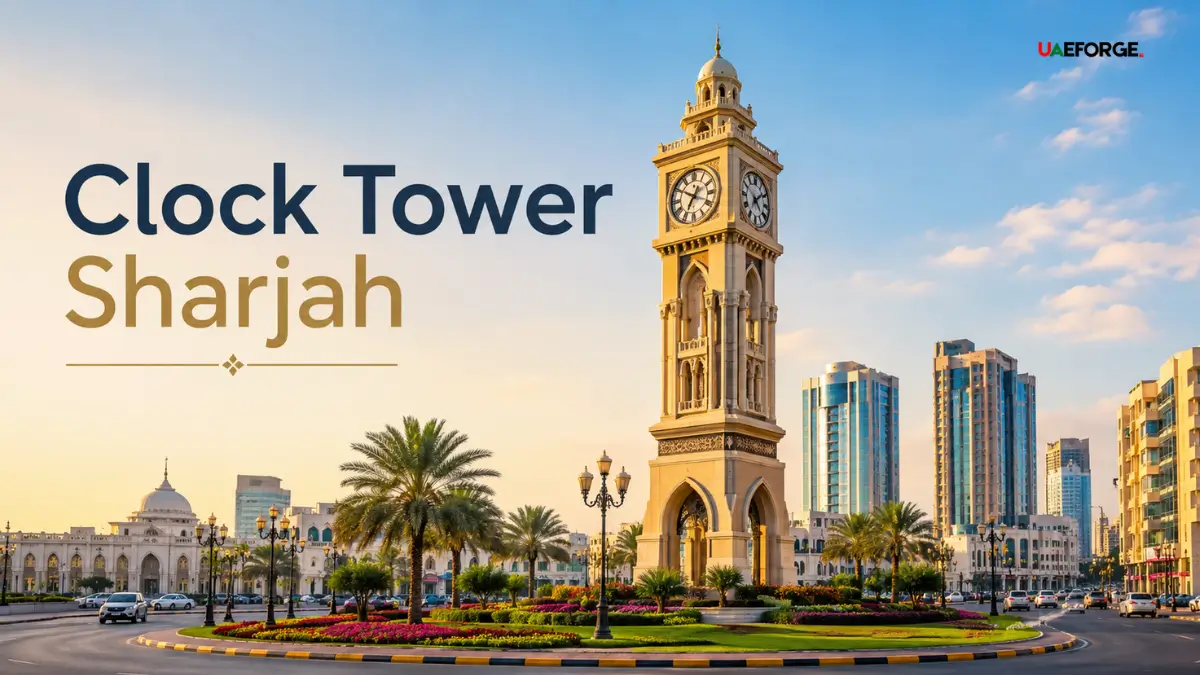
In the midst of the endless streams of traffic in Sharjah’s hectic intersections, on the blazing hot roads, there’s a second when you look up and suddenly feel the weight of time, not heavy and burdensome, but quiet and grounding, like a truly enduring landmark. The Clock Tower Sharjah does just that to every one who comes across it for the first or thousandth time.
The Sharjah Clock Tower is more than just a public timepiece – it rises majestically at one of the emirate’s busiest roundabouts. It’s a testament to the city’s evolution, from a humble coastal trading hub to one of the UAE’s most culturally vibrant cities. It is used by locals as a means of navigation. Families pose by it. It is the point from which all visitors embark on a trip to Sharjah.
From its history to its architecture, cultural significance, and nearby attractions, to tips for maximizing your experience, here’s everything you need to know about the Clock Tower Sharjah. Whether you’re traveling, conducting research or just curious about one of the Gulf’s most popular urban icons, you’ve landed in the right place.
Clock Tower in Sharjah is a Historical Landmark
To understand the Clock Tower Sharjah, it’s important to understand the era it was born into. The tower was built in 1966 when Sharjah and the Gulf region were in a period of significant change. The emirate was at that time evolving from a traditional settlement economy to a modernising urban centre, and was discarding old architectural forms for new civic structures which expressed notions of progress and ambition.
The Clock Tower was designed both as a functional public building and a symbolic gesture. It was to be at a strategic crossroads, and was designed to cater for the increasing numbers of commuters and city dwellers, and also provide a visual focus — a focus which would provide people with a sense of belonging, a sense of identity. The tower soon became a landmark in Sharjah’s developing urban fabric, captivating the interest of residents and attracting the attention of tourists.
The timing of this origin story is what makes it so interesting. In fact, the UAE was established just five years after the construction of the Clock Tower in 1971. The Clock Tower Sharjah has literally been an integral part of the birth of the country. It has seen all the phases of modern history of the emirate – the economic diversification, the cultural renaissance, the fast-growing population and Sharjah’s designation as the cultural capital of the Arab world in 1998 and as the UNESCO’s World Book Capital.
The tower was not just a survivor of these decades of change. It engulfed them and each year it grew deeper in meaning.
Architecture and Design: Where Islamic Elegance Meets Urban Function
The most common question asked regarding Sharjah Clock Tower is what does it look like? The response is both bold and deliberate.
The symmetrical and elegant design of the Clock Tower Sharjah is inspired by Islamic architectural traditions. It has a good amount of geometric precision and clean vertical lines, and has a visual dignity that is different from the other commercial buildings without being overwhelming. The general shape is clearly that of a towering structure with a central body that appears to be connected to a roundabout, with a top section containing four large clock faces, each pointing in a distinct direction.
It’s not just any ordinary clock face. They are roughly 43 metres in diameter and one of the largest clock faces in the world and can be seen for some distance across the city. The tower’s glowing clock faces and domed roof make the structure a wonderful beacon of light in the evening that has become a favorite spot for photographers and late-night walkers. The interplay of light and shadow on its geometric façade gives it a cinematic quality, making night-time visits particularly rewarding.
The tower is also 163-metres tall and one of the tallest buildings in the central part of Sharjah. The elevation provides panoramic views of Khalid Lagoon, the surrounding cultural quarters and the ever growing landscape of the city, which is a reward for the efforts of those who venture up to it from an observation vantage.
The concept of the Clock Tower Sharjah is based on a thought that Sharjah has always believed in: modernity and cultural heritages are not mutually exclusive. It is modern in its engineering materials but Islamic in its aesthetic sensibility. This equilibrium is not coincidental but an expression of the general cultural life of the emirate, which is open to the future but at the same time rooted in tradition.
Central Sharjah’s Location and Navigation – Clock Tower Sharjah
Go to almost anybody in Sharjah, and ask them about the location of the Clock Tower, and they wouldn’t hesitate. The site of the Clock Tower Sharjah is located at the junction of Khalid Lagoon Road and Al Hisn Road, one of the busiest and most popular crossroads in Sharjah.
It’s not a landmark that you just happened upon. It is the type of structure that cities are built around. The roundabout where it is installed is a junction between the main roads of Sharjah that connects residential areas, governmental buildings, commercial and cultural areas in a single hub. The Sharjah Art Museum, the Blue Souk, Al Majaz Waterfront and the historic Al Hisn Fort are all nearby, and the likelihood is that your trip will bring you close to the Clock Tower.
To the inhabitants this makes the tower an immediate point of reference, a mental pin on the map of the city. For tourists, it is even more valuable: an anchor in reality in an unknown city. Even if you have GPS, many first time visitors do better to just start off in the direction of the tower and then make their way to their destination.
The area is well provided with public transport and there are plenty of buses and taxis throughout the day and into the evening. There are pedestrian routes around the roundabout, which offer the opportunity to get up close and personal with the tower, but be careful when approaching the tower during rush hour at the roundabout.
Cultural Significance: Symbol That Belongs to the People
The Clock Tower Sharjah is not glassed up. Not roped off and not controlled by a ticket booth. It is a public landmark for all the people of Sharjah — it is open to all to admire, photograph and gather around, anytime of the day, in the most direct and democratic way.
The tower is significant for its open, communal nature. The neighborhood around the Clock Tower has developed into one of the most natural meeting grounds of the city over the decades. Evening walks and picnics are on the green patches nearby visited by the families. At sunset, photography buffs come to take some photos of the tower in the warm glow of the light and the pastel sky. The nearby trails are a favorite among fitness enthusiasts for jogging. The tower is also known to be decorated with flags and special lighting during national festivals and events, such as UAE National Day and Sharjah Heritage Days, making it a focal point for the festivities and attracting visitors from all over the emirate.
The Clock Tower’s cultural significance also has a nostalgic aspect. To those who have lived in Sharjah for extended periods, the tower is a symbol of personal memory, as well as civic history. This is where people met, before smartphones. It’s the backdrop of wedding photographs, family images and a thousand first visits to the city. The Clock Tower Sharjah is a landmark, a constant in a world that changes more rapidly than memory: a reliable, familiar face in a city that progresses without ceasing.
Sharjah is a City Where There’s Always Something to See and Do
The best use of the Clock Tower Sharjah is as a starting point to travel around the rest of the cultural district. Some of the emirate’s most popular attractions are just a few minutes drive or a walk away.
- Sharjah Art Museum — One of the largest and most esteemed art museums in the Gulf, boasting an outstanding collection of classical and modern Arab art. A must-visit for art lovers exploring the area.
- Al Majaz Waterfront – A stunning promenade along Khalid Lagoon, offering fountains, cafes, kids’ playgrounds and a popular, evening musical fountain display.
- Al Noor Mosque — One of the most photographed mosques in Sharjah, with impressive white domes and Islamic designs. It is accessible to non-Muslims during certain times.
- Heart of Sharjah — A beautifully restored heritage district, which reimagines the emirate’s traditional architecture, souqs and community life. Perfect to accompany this symbolism of the modern clock tower.
- Blue Souk (Central Market) — Sharjah’s most popular shopping center, a unique double-towered structure, selling gold, jewellery, fabrics, spices and souvenirs.
- Sharjah Museum of Islamic Civilization — A world-class museum of Islamic history, science and art, in a restored heritage building near the Corniche.
These sites collectively contribute to the cultural corridor of Sharjah, making it one of the best places for history enthusiasts, families, and those with a thirst for culture among the UAE’s destinations.
Some Useful Tips for Visiting the Clock Tower Sharjah
The best way to make the most of your visit to the Clock Tower Sharjah is to plan and time it properly.
- Ideal visiting hours: early morning for quiet, good photography opportunities, or evening for illuminating displays and cooler weather.
- Photography: best to photograph from a little distance away to show the height of the tower. The most dramatic results will be achieved by evening and twilight shots.
- Weekday vs. weekend: Weekdays tend to be quieter, allowing for a more relaxed experience around the roundabout and nearby paths.
- Weather: Summers are hot and humid in Sharjah. Bring water, use sun protection and look into visiting during the cooler months (October-April).
- Transport and parking: This is easy to reach by public bus, taxi and own transport, parking in commercial areas.
- Entrance: The Clock Tower and the surrounding area is free to enter.
Sharjah’s Newer Addition: Kalba Clock Tower
Aside from the main Clock Tower Sharjah, it is worth highlighting the newer Kalba Clock Tower, inaugurated by His Highness Sheikh Dr. Sultan bin Muhammad Al Qasimi, Ruler of Sharjah in January 2025. This modern building was built in the city of Kalba on Sharjah’s east coast, rising 60 metres above this coastal city, inspired by Islamic architecture, this building has a gilded mosaic dome and ornate decorative facades. Featuring two viewing decks, one at a height of 33 metres with a restaurant, and another at 46 metres offering panoramic views of Kalba Lake, the mangroves and the surrounding Hajar Mountains. The base is surrounded by 72 fountains, 12 of them representing hours and 60 representing minutes, thus establishing a poetic link to the concept of time. The original Clock Tower Sharjah and the Kalba Clock Tower both represent the emirate’s steadfast commitment to the meaningful construction of buildings that have ties to its culture.
Why Sharjah’s Clock Tower is Still Relevant
The Clock Tower Sharjah is the kind of power that is not involved in pushing the boundaries of physics, building record-breaking skyscrapers and artificial islands, or architectural spectacle, in an age of architectural spectacle. It doesn’t need to overwhelm you in size or novelty. It earns it through continuity, through consistency, through the quiet power of something having been here, steadfastly, in all the seasons of a city’s life.
It matters because Sharjah has always known that culture is not for decoration, it’s for infrastructure. The emirate that constructed one of the most renowned libraries in the Arab world, that hosts an internationally renowned book fair, that has been investing for decades in the construction of museums, art institutes and the preservation of heritage did not erect its Clock Tower Sharjah by chance. It constructed it as a proclamation: that time was not merely minutes in this place, but significance.
The Clock Tower Sharjah is a residence for the locals. For visitors, it’s a gateway to a city that rewards curiosity. For all those who have gazed at the four great luminous faces and felt, at least fleetingly, that there is something old and new that still holds sway in the modern world, it is a reminder that there are things that are worth holding on to.
FAQ’s
1. The Clock Tower Sharjah is situated in which area?
It is located in the city center of Sharjah, UAE on Khalid Lagoon Road and Al Hisn Road.
2. In which year was the Clock Tower Sharjah constructed?
Built in the early modernization era in Sharjah in 1966, this tower was designed by the late Sharjah architect Abdullah Al Qasimi, who drew inspiration from the architecture of the old town.
3. How tall is the Clock Tower Sharjah?
The tower rises to a height of about 163m, one of the tallest buildings in the heart of Sharjah.
4. What’s the size of the clock faces?
The four clock faces are about 43 meters in diameter, which is one of the largest in the world.
5. Are there any entrance fees to visit?
No. It’s completely free to visit the Clock Tower and the public space nearby.
6. Is it possible to go to the clock tower at night?
Yes. At night, the tower is lighted and many also prefer the evening as photography and for the cooler temperatures.
7. When is the ideal time to visit Sharjah’s Clock Tower?
The best time to visit the outdoors is from October to April.
8. What are the nearby landmarks of the Clock Tower Sharjah?
Sharjah Art Museum, Al Majaz Waterfront, Al Noor Mosque, The Blue Souk and Heart of Sharjah are some of the attractions nearby.
9. Can you park close to the Clock Tower?
Yes. The landmark is well serviced by public transport and parking is possible in surrounding commercial areas.
10. What is the significance of the Clock Tower Sharjah in culture?
Since 1966, it has been the hub, landmark, and cultural icon of Sharjah’s urban life, and symbol of its historical development.
Read Another Topic: Al Ain Bus Station UAE | A Complete Travel Guide

Leave a Comment