
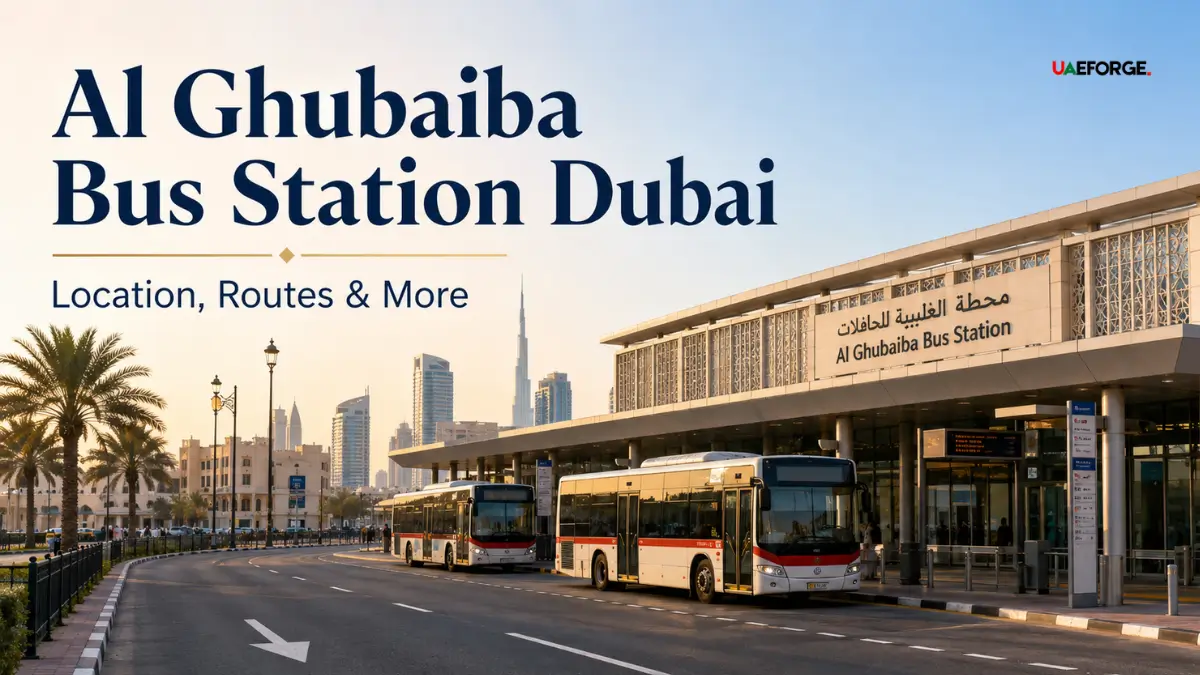
Located on the historic banks of the Dubai Creek, Al Ghubaiba Bus Station is one of the most culturally diverse and busy bus stations in the emirate. Al Ghubaiba Bus Station is not like the sleek, air conditioned metro stations of modern Dubai, but rather it’s the living reminder of how this city moved long before the skyline was born. It is its point of convergence for veteran travellers, budget travellers, tourist explorers and daily workers all under a single roof and heading for destinations throughout the UAE.
Al Ghubaiba Bus Station is a no-brainer for anyone looking to travel in Dubai on a budget, to explore the old districts, or simply get to the northern emirates without a car. This guide includes all the details, from where to find the station, its hours of operation, available routes, station facilities, options for connecting to other modes of transport, to tips from station personnel to ensure your trip is smooth and hassle-free.
Al Ghubaiba Bus Station can be Found Where?
Located in the Bur Dubai area, opposite the Dubai Creek. It is at a specific address and is very close to Al Ghubaiba Metro Station on the Red Line of the Dubai Metro, Al Seef Road. It is an old part of the city of Dubai, characterized by the souks, the architecture of the wind towers, the water taxis and the density of the culture that attracts historians and visitors.
The station is strategically located in Dubai, between two of the most popular heritage areas of the city:
- A short walk to the south is the Al Fahidi Historical Neighbourhood.
- Somewhat further to the south lies the Al Fahidi Historical Neighbourhood.
- The Dubai Museum is just a stroll to the south-east.
- Bur Dubai Abra Dock, steps away to cross creek to Deira
The location of Al Ghubaiba Bus Station is not a coincidence. The bus station was also located in a place that was a vital part of Dubai’s commercial life, and developed along the traffic of people who worked in the souks, lived in the older residential quarters and came from neighbouring emirates to trade.
A Brief Account of the History of Al Ghubaiba Bus Station
Al Ghubaiba is one of Dubai’s oldest planned bus terminals. It can be traced back to the founding days of Dubai’s public transport system when the Roads and Transport Authority (RTA) or its predecessor bodies laid the groundwork for formal bus lines to connect the developing city. For decades, the station has been the core of the bus service in Bur Dubai; it steadily grew from a small stop to a multiple-bay facility that carries thousands of passengers per day.
But what makes Al Ghubaiba Bus Station historically significant is not only its age, but its continuity. Dubai has developed at an astonishing rate, airports, metro lines, expressways; while Al Ghubaiba, has changed, but not, yet, because it remains a community centre for people who live and work in old Dubai.
Bus Routes Operating From Al Ghubaiba
Al Ghubaiba Bus Station serves as a key bus hub for a comprehensive network of local and intercity buses traveling throughout Dubai and to and from the other northern emirates, Sharjah and Ajman. The following is a summary of the significant routes that the station serves.
Local Dubai Routes
Al Ghubaiba local bus network links with Dubai’s most significant areas and districts. From this station key local routes include:
- Deira (via the bus bridge or metro interchange)
- Al Quoz-Like Al Barsha, Al Quoz links the old Dubai to newer commercial districts.
- Karama and Satwa, which serve the very densely populated residential areas,
- The Jumeirah, a bridge that links the heritage district with the beach corridor.
- Al Muhaisnah and Mirdif (in the eastern residential areas).
- Rashidiya and Al Qusais (to Dubai International Airport)
- Dubai Investment Park — Industrial/Residential area in the extreme south.
Bur Dubai and Al Ghubaiba are often linked with Route Numbers in the 40s, 50s and 60s, although the RTA does periodically change numbers. The RTA website and the Dubai Metro App are recommended to travellers to check the latest route numbers before travelling.
Intercity and Northern Emirates Routes
Al Ghubaiba Bus Station is perhaps the most strategically important station, as a gateway to the northern emirates. Thousands of workers and residents from Dubai set off daily for their places of work and residence in Sharjah, Ajman, Umm Al Quwain and Ras Al Khaimah.
Important intercity roads are:
- Dubai to Sharjah (Al Jubail Bus Station) is one of the busiest cross emirate routes in the UAE; there are high frequency services operating throughout the day.
- Dubai to Ajman — Dubai to Ajman Bus Station for onward travel in Ajman emirate
- Intercity service between Dubai and Umm Al Quwain — a longer journey that mainly serves residents and employees
- Ras Al Khaimah to Khorfakkan — the longest coastal run, to connect the southernmost city with the northernmost emirate.
Far more affordable, these intercity services are run by the transport authorities of each emirate, in conjunction with Dubai’s RTA, and are the lifeline for the substantial population of Dubai who live outside the emirate.
Operating Hours (times) of Al Ghubaiba Bus Station
Al Ghubaiba Bus Station is open on all the days and at different hours, depending on the routes provided. The general functioning procedures are:
- First departures: Most local routes from about 5:30 AM to 6:00 AM
- Last departures: 11:00 PM to midnight for most of the routes; some high-demand routes run afterwards.
- Friday and holiday services: Services are at reduced frequency in the morning during prayer time on Friday; services return to a full frequency service by early afternoon.
- Intercity routes: Usually operate from early morning to late evening, such as the last Sharjah train, which will generally leave around 11:00 PM.
Please note that it is always best to consult the RTA Dubai Smart App or visit rta.ae for up-to-date schedule information, due to the possibility of changing frequencies or last bus times during the season or public holidays.
The facilities and amenities at Al Ghubaiba Bus Station include:Al Ghubaiba Bus Station provides the following facilities and amenities:
- Although Al Ghubaiba is not a shining example of a megastructure, it provides a practical set of facilities that make the waiting and travelling convenient for most travellers:
- Covered Waiting Bays: All bus boarding areas are covered from the sun and rain which is very important in Dubai as it is very hot in the summer months. Waiting areas are air-conditioned, especially in the summer (June to September) when temperatures outside the vehicle are often above 40°C.
- Passengers who want to buy and recharge their Nol Card Dubai’s single payment transport card are able to do so at the station. A minimum balance is needed to board RTA buses or the metro – cash is not accepted on most routes and the Nol card is required to board.
- Retail and Food Options: The station has little retail or food options and is surrounded by small kiosks, convenience stores and food counters. It is located in old Bur Dubai where many restaurants and cafeterias with a variety of cuisines are available, ranging from the South Asian cuisine to Middle Eastern and Filipino dishes, which are popularly enjoyed by the area’s diverse population.
- Restroom Facilities: The station has public restrooms, which may be tidy at times that are not peak hours.
Passengers are guided to the appropriate bay and route by Information Points, which are manned by staff who are also available for queries and answers.Information Points are staffed and informational boards to help passengers locate the proper bay and route. The RTA app has greatly diminished the need for on-site guidance while still allowing for the availability of human assistance.
In keeping with the RTA’s broader accessibility commitments in Dubai’s public transportation system, accessibility features include ramps and designated boarding assistance for passengers with mobility impairments.
How to Get to Al Ghubaiba Bus Station?
By Dubai Metro
The quickest way to get to Al Ghubaiba Bus Station is by Al Ghubaiba Metro Station, which is located on the Red Line of the Dubai Metro. The outdoor walkway (also covered) between the metro station and bus terminal makes it easy to transfer even in extreme heat.
By Abra (Water Taxi), by Abra (Water Taxi)
The abra, or traditional wooden water taxi, which ferries passengers across Dubai Creek between Bur Dubai and Deira in just a few minutes for a small fee, is one of Dubai’s most iconic experiences. The Bur Dubai Abra Station is close to Al Ghubaiba Bus Station which is easy to get to from the Gold, Spice souks in Deira, as well as the bus station.
By Taxi or Ride-Hailing
Careem/Uber cars and RTA taxis are allowed to drop at the station entrance. Drivers know where the station is, especially those who are familiar with the Bur Dubai area and the address is well known.
By Walking (From Nearby Attractions)
The bus station is a short walk from the Dubai Museum, via the creek promenade, which is a nice route in cooler weather (10-15 mins).
In this guide, you’ll learn everything you need to know about Nol Card before you board.
The Nol Card is an indispensable necessity for taking Dubai’s public buses. The Nol Card is an electronic contactless smartcard that allows users to use it on buses, the metro, trams and water buses as introduced by the RTA to bring simplicity to the transit payment system.
There are four types of Nol cards:
- Red Card (Silver): The most popular, available at AED 6 for occasional travellers.
- Stored Value or Unlimited Transfers (Gold): For regular commuters who need to use multiple modes of transportation.
- Silver Card: an upgraded card with higher balance limits.
- Gold Card: Card with discount monthly passes (subscription based)
Red and Blue Nol cards can be bought or topped at vending machines and Customer Service at Al Ghubaiba Bus Station. A minimum balance of AED 20 is recommended before travelling with more than one connection, because if there is less balance than this it won’t be possible to board the trip.
Few Recommendations to First-time Visitors to Al Ghubaiba Bus Station
- For Intercity Services: The Sharjah and Ajman buses are especially full during peak hours and therefore it is best to arrive early. It is highly recommended that you arrive 15-20 minutes early for your intended departure.
- RTA App: RTA Dubai Smart App is available for both iOS and Android and offers real-time bus tracking, planning and scheduling. This is probably the best option to use on the Dubai bus network.
- Dress Appropriately: Al Ghubaiba is located in a conservative area that is heavily trafficked with religious sites and traditional markets. Modest dress is considered to be respectful and practical.
- Avoid Peak Hour Travel: The station is very busy during the peak hour (between 7:00 AM and 9:00 AM, and 5:00 PM and 8:00 PM). Allow extra time when traveling during these times.
- No Ticket Windows for single bus journeys – Keep Your Nol Card Topped Up. The only way to get on an RTA bus is with a Nol card.
- Language diversity among passengers does not hinder any difficulties in the services provided by RTA’s staff at Al Ghubaiba Bus Station, which is generally helpful and experienced to assist travelers who do not speak Arabic.
- For Intercity Transfers: If you are travelling to Sharjah or Ajman, please keep in mind that you will have to make use of the bus network system of the emirate on arrival there, which may involve a different payment system or cash in some cases.
Major Bus Stations of Dubai are the Properties of Al Ghubaiba
There are several bus stations in Dubai. Knowing the comparison of Al Ghubaiba Bus Station facilitates travelers to select the appropriate hub for their travel:
| Station | Location | Primary Purpose |
| Al Ghubaiba | Bur Dubai / Creek | Old Dubai local + intercity to northern emirates |
| Union Square | Deira | Central hub with metro interchange; major northern routes |
| Al Quoz | Al Quoz | South and industrial zone connections |
| Ibn Battuta | Jebel Ali | Western Dubai and Abu Dhabi corridor |
| Gold Souq | Deira | Northern Deira local services |
Al Ghubaiba Bus Station continues to be the preferred destination for travelers from the heritage areas along the creek and those traveling to Sharjah, Ajman and further into the northern emirates.
Neighborhood of Al Ghubaiba is a Place Where You Can Visit and Discover
To get to Al Ghubaiba or to leave is a great chance to explore one of the most culturally authentic neighbourhoods of Dubai. Within a short distance:
- Al Bastakiya: Al Al-Khadmi means Historical Neighbourhood; Area with preserved houses of wind-towers built in the early 20th century. It is here that the true architectural spirit of old Dubai continues and where there are several little museums, galleries and courtyard cafes.
- Dubai Museum: The museum is located in Al-Fahidi Fort, the oldest surviving building in Dubai, and it chronicles the evolution of a pearl fishing village into one of the most modern cities in the world.
- Bur Dubai Souk: A covered market offering fabrics, clothing, and everyday items – it is a popular spot for tourists to buy souvenirs as well as for locals to shop for practical items.
- Dubai Creek Promenade: The walk along the waterfront of Dubai Creek will allow you to see some typical wooden dhows, abra (dhow) crossings, and contrasting skylines of Bur Dubai and Deira.
- Grand Mosque of Bur Dubai: One of the biggest and beautiful mosques in Dubai which is located just a few minutes away from the station.
The RTA’s Sustainability and Vision for Public Transit
The RTA’s long-term plan for the city of Dubai to decrease the dependency on private vehicles is part of this effort. The emirate’s Dubai 2040 Urban Master Plan has ambitious plans for the use of public transport, with targets for modal share that are well higher than current levels. The integration of the bus network, especially in the areas of dense development and mixed income such as Bur Dubai, is a key element of this vision.
The RTA has gradually implemented air-conditioned bus stops, real time tracking, electric buses for selected lines and Nol card payment on all services, which will impact the Al Ghubaiba operations. Additional improvements could involve improved walkways to connect the metro and bus bays and digital information panels, which will further improve the passenger experience.
Conclusion
Al Ghubaiba Bus Station is a place of ground and essentiality, despite Dubai’s futuristic transport vision, the hyperloop concepts, the autonomous vehicles and the busiest international airport in the world. It is the place where the workaday life of the city is revealed, where the cross-emirate commuters go off and come back, where the budget travelers go, where the heritage tourists run into it when they wander up and down the creek.
Knowing Al Ghubaiba is knowing one part of Dubai that the glossy travel guides avoid. It is able to do what it needs to do, it’s simple, it’s rooted in history and it’s actually useful. From the point of view of a local person seeking to make the best of their trip to work or a tourist interested in how the real majority of the city makes its way from point A to point B, Al Ghubaiba Bus Station is worth a visit, if not a ride.
Frequently Asked Questions (FAQs)
2. What is the address of Al Ghubaiba Bus Station in Dubai?
Al Ghubaiba Bus Station is situated in Al Bur Dubai in the Dubai Creek waterfront area next to Al Ghubaiba Metro Station on the Red Line.
2. What is the nearest metro station to Al Ghubaiba Bus Station?
Al Ghubaiba Metro Station on the Dubai Metro Red Line is the closest metro station, which is linked to the bus terminal with a covered walking path.
3. Is there a bus service from Al Ghubaiba Bus station to Sharjah?
Al Ghubaiba is indeed one of the key points for the origin of intercity buses that leave for Al Jubail Bus Station in Sharjah and the buses operate throughout the day and night.
4. What are the working hours of Al Ghubaiba Bus Station?
The majority of routes run between 5:30–6:00 AM and 11:00 PM to midnight. There is also the specific timetable for intercity services to the northern emirates on the RTA app and website.
5. Is there a cash-paying option to use cash to pay for the bus at Al Ghubaiba?
Yes, Dubai RTA Buses have implemented Nol Card for payment. No cash will be accepted on board. Nol cards can be purchased and topped up at the station.
6. Does Al Ghubaiba Bus Station have air conditioning?
The waiting areas and bus shelters have air-conditioning and covered canopies. Cooling is a feature of waiting rooms indoors, particularly during the summer months in Dubai.
7. How to get to Al Ghubaiba Bus Station from Dubai International Airport?
One can take the Red Line Metro transportation from the Airport Terminal 1 or Airport Terminal 3 stations directly to Al Ghubaiba Metro Station and proceed by walking to the bus terminal. Please allow about 25-35 minutes for this trip.
8. Is there any bus from Al Ghubaiba to Ajman?
Yes, there are intercity buses from Al Ghubaiba to Ajman. These are some of the popular commuter and resident traffic corridors between the two emirates.
9. What is a Nol Card and what is the station where I can get it?
The Nol Card is Dubai’s contactless payment card that is accepted on all modes of transportation under the RTA. It is available for purchase and recharges within the station at vending machines and at the customer service counters.
10. What is the fare for the buses?
The station and area is generally safe. The Bur Dubai area is a very active, populated area. Standard precautions – valuables stored safely and awareness of surroundings – are the same as in any busy transit hub in any part of the world.
Read Another Topic: Al Ain Bus Station UAE
Leave a Comment