
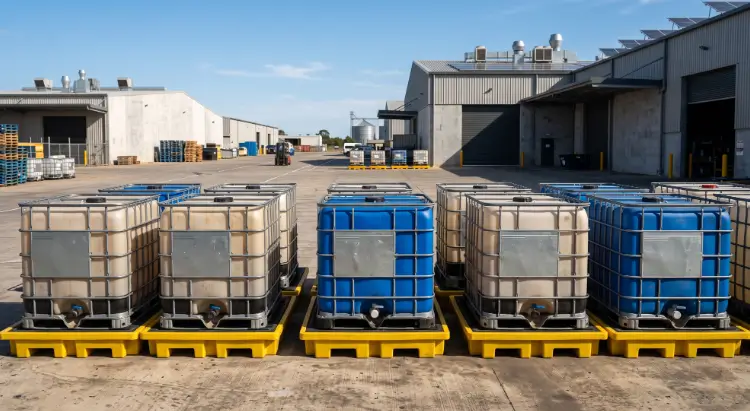
Bulk liquid containers look fairly similar from the outside, a boxy frame, a plastic inner vessel, a valve at the base. But the decision behind choosing one involves more than picking a size off a shelf.
Get it wrong, and you end up with a container that’s incompatible with your liquid, too small for your operation, or missing certification you didn’t realize you needed. Here are the questions worth answering before you buy.
What Liquid Will You Actually Be Storing?
This is the question everything else depends on. The liquid you’re storing determines which container material will hold up over time and which will slowly degrade, react, or contaminate what’s inside.
Water and general non-hazardous liquids have fairly minimal requirements. Chemicals, solvents, and hazardous materials need a container material specifically compatible with that substance, checked against a chemical resistance chart rather than assumed. Skipping this step is the most common reason containers fail earlier than expected.
How Much Volume Do You Actually Need?
Bulk containers come in a range of capacities, but the industry-standard size tends to sit around 1,000 liters, offering a practical balance between capacity, footprint, and ease of handling.
Going bigger increases weight and space requirements substantially, while going smaller may mean more frequent refills or a less efficient handling process.
A well-sized ibc tank from Crateco Pack LLC at this standard capacity covers most industrial applications without requiring specialized lifting equipment or an oversized storage footprint.
Does the Container Need Specific Certification?
If you’re storing or transporting hazardous materials, certification isn’t optional. Containers used for this purpose typically need UN or DOT approval, along with markings confirming the container has been tested and rated for that classification of liquid.
Even for non-hazardous liquids, it’s worth checking whether your industry has its own compliance requirements, food-grade certification, for instance, if the container will hold anything intended for consumption.
New or Reconditioned: Does It Actually Matter?
A new container guarantees full certification and a clean history, but it comes at a higher cost. A reconditioned container, properly cleaned, inspected, and refurbished, can offer real savings for less sensitive applications, provided it’s been through a genuine inspection process rather than just a rinse and resale.
For hazardous or highly sensitive liquids, a new, fully certified container is usually the safer choice. For general storage needs, a quality reconditioned unit can perform just as well at a lower cost.
What Valve Setup Actually Fits Your Liquid?
Not every valve works well with every liquid. Thinner, free-flowing liquids generally work fine with a standard ball valve, while thicker or more viscous liquids may need a butterfly valve designed to handle a wider flow path without clogging.
It’s a small detail that gets overlooked often, but the wrong valve setup can turn routine dispensing into a slow, frustrating process every single time the container needs to be used.
Will It Actually Fit Your Space and Equipment?
A container that holds the right volume doesn’t help much if it doesn’t fit through your doorways, sit properly on your racking, or get moved easily with the forklift or pallet jack your team already uses.
Check the container’s footprint against your storage layout before committing, and confirm it’s compatible with your existing material handling equipment. A container that requires new equipment just to move it adds cost that often doesn’t show up until after purchase.
What Happens to the Container Once It’s Empty?
Bulk containers are built to be reused, but that only holds true if you have a plan for cleaning, inspecting, and recertifying them between uses. Containers that previously held incompatible substances can also affect what’s safe to store in them next, so their history matters as much as their current condition.
Facilities that plan for this upfront tend to get significantly more use out of each container instead of treating it as a single-use purchase.
Conclusion
Choosing a bulk liquid container comes down to a handful of questions that are easy to skip and expensive to get wrong: what the liquid actually needs, how much capacity makes sense, whether certification applies, and whether the container fits how your site actually operates. Answering these upfront saves far more time than dealing with a mismatched container after it’s already in use.







Leave a Comment